
Bitaxe or Nerdaxe: differences, every model and which miner suits you
3 April 2026 · 13 min read · Updated on 26 September 2026

Bitaxe and Nerdaxe are the two device families most home mining starts with today. They use the same Bitmain chips, are operated in a browser and often sit next to each other on the shelf. Still, they differ more than it seems at first glance: in the display, in the firmware, in the factory settings and, from four chips upwards, in the performance class. This comparison puts every model of both families side by side with the values their firmware sets out of the box, explains the differences between AxeOS and NerdOS and says which device fits which use case better. As of 26 September 2026, AxeOS 2.15.3 and NerdOS 1.1.0.1.
Where Bitaxe and Nerdaxe come from
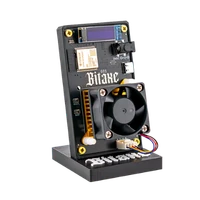
The Bitaxe is the open reference design Skot develops with the community under bitaxeorg: one or more Bitmain ASICs on an open board, controlled by an ESP32-S3 and operated through AxeOS in the browser. Schematics, board layout and firmware are public.
The Nerdaxe comes from BitMaker, who is also behind the NerdMiner v2. According to its repository the Nerdaxe is a fork of the Bitaxe with a colour display, meant as an upgrade for people who already own a NerdMiner. That is why the controller sits on the same module a NerdMiner uses, a LILYGO T-Display S3 with ESP32-S3 and 1.9-inch colour display. The chip underneath is the same as in the Bitaxe.
The larger Nerd devices go back to shufps. He designed the NerdQaxe+ and NerdQaxe++ (hardware) and writes the firmware for the whole range, NerdOS, which today also runs on the Nerdaxe. The NerdOctaxe is a design by Patsch91 based on the NerdQaxe, the NerdQX comes from Ix Tech, and for the Nerdaxe Gaia BitMaker maintains its own branch of NerdOS. What all Nerd devices share is NerdOS as their firmware.
For you that means: chips, pool values and the chance of a block are comparable across both families. Operation, menus, factory settings and protection features differ, because two different firmwares are running. A guide for the Bitaxe therefore does not apply one to one to the Nerdaxe.
A Nerdaxe is not a NerdMiner
The names cause a lot of confusion. A NerdMiner is an ESP32 board with a display whose processor computes hashes itself. That is good for a few tens of kilohashes per second; a NerdMiner v2 Pro reaches about 75 kH/s. A Nerdaxe uses the same display module only for control and readout. The hashing happens on a Bitmain ASIC, about 1.05 TH/s out of the box on the Nerdaxe Gamma. That is roughly 14 million times as much.
The difference also shows in the blocks found. Con Kolivas, who runs solo.ckpool.org, wrote in August 2024: “A nerdminer has never solved a block, and likely never will.” (source). Devices with an ASIC, on the other hand, have verifiably found blocks: five Bitaxe since July 2024, plus in April 2026 a worker named “NerdOCTAXE” (block 943,466) and a NerdQaxe++ (block 944,078). How rare that still is, is worked out in finding a block with a Bitaxe.
Chip generations: from BM1366 to BM1373
Both families use the chips Bitmain makes for its large Antminers. Which chip sits on a device determines almost everything: hashrate per chip, power draw and efficiency. AxeOS and NerdOS calculate the expected hashrate with the same formula: clock × cores × number of chips. A Gamma at 525 MHz thus comes to 525 × 2,040 = 1,071 GH/s, or 1.07 TH/s.
| Chip | Origin | Cores | Factory clock | Hashrate per chip out of the box | Devices |
|---|---|---|---|---|---|
| BM1366 | Antminer S19 XP | 894 | 485 MHz | 0.43 TH/s | Bitaxe Ultra, first Nerdaxe |
| BM1368 | Antminer S21 | 1,276 | 490 MHz | 0.63 TH/s | Bitaxe Supra, Bitaxe 702 (6 chips), NerdQaxe+ (4 chips) |
| BM1370 | Antminer S21 Pro | 2,040 | 525 MHz on the Bitaxe, 515 to 777 MHz on the Nerd devices | 1.07 TH/s at 525 MHz | Bitaxe Gamma, Copperzilla, GT (2), Nerdaxe Gamma, NerdQaxe++ (4), NerdQX (4), NerdOctaxe (8) |
| BM1373 | latest generation, first in an open miner in 2026 | 6,860 (marked as provisional in NerdOS) | 350 MHz | 2.40 TH/s | Nerdaxe Gaia |
The older chips hardly matter for a new purchase any more. The first Nerdaxe with BM1366, called “Nerdaxe Ultra” by BitMaker, computes about 0.43 TH/s out of the box (BitMaker quotes about 0.5 TH/s) and is set up in NerdOS exactly like the Nerdaxe Gamma. The NerdQaxe+ with four BM1368 delivers about 2.5 TH/s at 55 W according to shufps. The BM1373 in the Gaia, by contrast, is the current top: a single chip computes more than the two BM1370 in the Bitaxe GT. More on that in the article on the Nerdaxe Gaia.
The Bitaxe family

The two model tables list the firmware’s factory settings and the hashrate it expects from them. On an individual device the measurement is a little higher or lower depending on chip, temperature and power supply. Unless noted otherwise, power figures come from developers and manufacturers; for the Gamma it is our own measurement at the wall socket.
| Model | Chips | Factory setting | Expected | Power | Display | Power supply | Price |
|---|---|---|---|---|---|---|---|
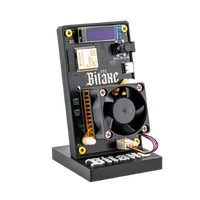
| Bitaxe Gamma 601 | 1 × BM1370 | 525 MHz / 1150 mV | 1.07 TH/s | about 17 W | 0.91" OLED | 5 V / 6 A (30 W) | €139.00 |
| Bitaxe Copperzilla | 1 × BM1370 | 750 MHz / 1200 mV (OSM-OS) | 1.53 TH/s | 23 to 30 W (test series at 750 MHz) | 0.91" OLED | 5 V / 6 A (30 W) | €179.00 |
| Bitaxe GT 801 | 2 × BM1370 | 525 MHz / 1150 mV | 2.14 TH/s | about 43 W (retailer figure) | 0.91" OLED | 12 V / 5 A (60 W) | €229.00 |
| Bitaxe 702 (Supra Hex) | 6 × BM1368 | 490 MHz / 1166 mV | 3.75 TH/s | 75 to 90 W | 0.91" OLED | 12 V / 10 A (120 W) | €239.00 |
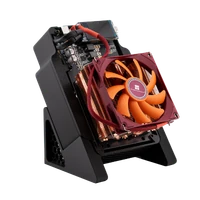
The Gamma is the device most people start with: one chip, one 40 mm fan and a 5 V power supply with a barrel plug; the USB-C socket is for flashing, not for power. AxeOS expects 1.07 TH/s out of the box, in everyday use the Gamma shows about 1.1 to 1.2 TH/s at about 17 W, which is 14 to 16 J/TH. The Copperzilla is electrically the same Gamma 601 with a massive copper heatsink; its OSM-OS profile sets 750 MHz and 1200 mV out of the box. How much it draws depends on the voltage: test series on Gammas at 750 MHz range from 23 to 30 W.
The GT doubles the chip and runs on 12 V. The 702 gets its hashrate from six BM1368 of the previous generation. AxeOS expects 3.75 TH/s out of the box; power is about 75 W according to the hardware documentation of its predecessor 701 and about 90 W according to retailers. At 20 to 24 J/TH it is the Bitaxe model with the most hashrate, but also with the weakest efficiency.
The Nerd family

| Model | Chips | Factory setting | Expected | Power | Display | Power supply | Price |
|---|---|---|---|---|---|---|---|
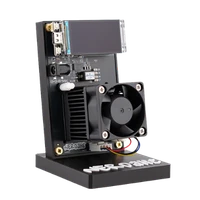
| Nerdaxe Gamma | 1 × BM1370 | 515 MHz / 1150 mV, with OSM-OS 650 MHz | 1.05 TH/s, with OSM-OS 1.33 TH/s | similar to the Bitaxe Gamma | 1.9" TFT | 5 V / 6 A (30 W) | €159.00 |
| Nerdaxe Gaia | 1 × BM1373 | 350 MHz / 940 mV | 2.40 TH/s | 26 to 30 W (manufacturer) | 1.9" TFT | 12 V / 6 A (72 W) | €249.00 |
| NerdQaxe++ | 4 × BM1370 | 600 MHz / 1150 mV | 4.90 TH/s | about 76 W (developer) | 1.9" TFT | 12 V / 10 A (120 W) | €349.00 |
| NerdQaxe Copper Pro | 4 × BM1370 | as NerdQaxe++ | 4.90 TH/s | as NerdQaxe++ | 1.9" TFT | 12 V / 10 A (120 W) | €599.00 |
| NerdQaxe++ Hydro | 4 × BM1370 | as NerdQaxe++ | 4.90 TH/s, about 6 TH/s at a higher clock | about 100 W at 6 TH/s (community measurements) | 1.9" TFT | 12 V / 10 A (120 W) | €499.00 |
| NerdQX | 4 × BM1370 | 777 MHz / 1200 mV, eco 495 MHz | 6.34 TH/s | up to 160 W (manufacturer) | colour display | 12.4 V / 20 A | €469.00 |
| NerdOctaxe | 8 × BM1370 | 700 MHz / 1210 mV (from rev. 3.0) | 11.42 TH/s | 160 to 200 W (manufacturer) | 1.9" TFT | 12 V / 20 A, XT60 plug | €699.00 |
| NerdOctaxe Hydro | 8 × BM1370 | as NerdOctaxe | 11.42 TH/s, overclocked up to 13.9 TH/s | about 155 W at 700 MHz, 230 W at 13.9 TH/s (test) | 1.9" TFT | 12 V / 20 A | €799.00 |
The Nerd range starts with the Nerdaxe Gamma, technically a Bitaxe Gamma with a colour display. With the original firmware it runs at 515 MHz out of the box, with OSM-OS from flasher.bitaxe.de at 650 MHz. There is no published power measurement of its own; with the same chip, the same core voltage and the same voltage regulator it sits in the same range as the Bitaxe Gamma. The Gaia is the most efficient device of both families at 11 to 12.5 J/TH.
From four chips it becomes a different kind of device. The NerdQaxe++ delivers a good four times the hashrate of a Gamma; Copper Pro and Hydro use the same board and the same firmware with stronger cooling and therefore more headroom for overclocking. The details are in the NerdQaxe++ review. The NerdQX runs its four chips at 777 MHz out of the box, the NerdOctaxe doubles to eight chips; its developer states explicitly that the board is not designed for overclocking.
Bitaxe Gamma versus Nerdaxe Gamma in detail
The choice is hardest in the entry class, because both devices look almost the same. Under the fan sits the same BM1370 with the same type of voltage regulator (TPS546 from Texas Instruments), and both run on 5 V. The differences are in the display, the firmware and the factory settings.
| Bitaxe Gamma | Nerdaxe Gamma | |
|---|---|---|
| Chip | 1 × BM1370 | 1 × BM1370 |
| Controller | ESP32-S3 on the board | ESP32-S3 on the plug-in LILYGO T-Display S3 |
| Display | 0.91-inch OLED, 128 × 32 pixels, monochrome, screens one after another | 1.9-inch colour display with several pages |
| Firmware | AxeOS 2.15.3 | NerdOS 1.1.0.1 |
| Out of the box | 525 MHz / 1150 mV, expected 1.07 TH/s | 515 MHz / 1150 mV, expected 1.05 TH/s; with OSM-OS 650 MHz, 1.33 TH/s |
| Fan out of the box | automatic control to 60 °C, at least 25 % | original firmware fixed at 100 %, OSM-OS automatic control to 60 °C |
| Overheat protection | above 75 °C chip or 105 °C regulator: stop, then continues automatically with 100 MHz and 100 mV less | from 70 °C (“Shutdown Temperature”): chip off, restart needed afterwards |
| Power | 5 V via barrel plug, 30 W power supply | 5 V via barrel plug, 30 W power supply |
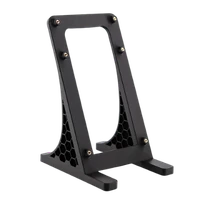
| Form | open board on a stand | mount or case, chosen at purchase |
| Cooler upgrades | ICE Tower, ICE Tower Low Profile, AXP60 Copperzilla | the same coolers fit |
The display is the most visible difference. The small OLED on the Bitaxe is enough to read the IP address during setup; to keep an eye on the miner you open AxeOS in the browser. The Nerdaxe’s colour display shows hashrate, temperatures, voltages and power large enough to read from across the desk. If the miner stands where you can see it, you benefit every day; if it goes on a shelf and you watch it in the browser, you do not need it.
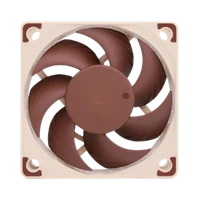
For noise, fan control matters most, since both have a 40 mm PWM fan. AxeOS regulates it to 60 °C chip temperature out of the box and never lets it drop below 25 %. The Nerdaxe’s original firmware, by contrast, runs it at a fixed 100 % until you select automatic control (PID) in the settings; OSM-OS sets that from the factory. With automatic control both are quiet in normal operation and audible under load. A test on draeger-it.blog measured 41.8 dB on a Bitaxe Gamma from 5 cm away with the stock fan and 30 dB with a Noctua NF-A4x20 5V PWM; we know of no published measurement for the Nerdaxe Gamma. You can fit the Noctua NF-A4x20 to both; more in making a Bitaxe quieter.
For the power supply there is no difference: both run on 5 V through the barrel plug, the included 5 V / 6 A adapter is enough, a phone charger is not. Everything else is in the power supply guide. Accessories are interchangeable too: ICE Tower Kit, ICE Tower Low Profile and AXP60 Copperzilla fit the Bitaxe Gamma and the Nerdaxe Gamma, but not the NerdQaxe.
Both can be overclocked. In AxeOS you unlock free values by adding ?oc to the address of the settings page, in NerdOS with the inconspicuous “Danger Zone” button in the Mining Settings. On the Nerdaxe Gamma NerdOS sets no upper limit for clock and voltage, so caution is up to you. How far you can safely go is covered in the overclocking guide.
Firmware compared: AxeOS 2.15 and NerdOS 1.1
Both firmwares come from the same project, ESP-Miner, but have grown apart. The table shows the state of AxeOS 2.15.3 (20 September 2026) and NerdOS 1.1.0.1 (24 September 2026), checked in the source code of both projects.
| AxeOS 2.15.3 (Bitaxe) | NerdOS 1.1.0.1 (Nerd range) | |
|---|---|---|
| Development | bitaxeorg | shufps; a separate branch by BitMaker for the Gaia |
| Interface language | English | nine languages, including English and German |
| Menu | Dashboard, Scoreboard, Swarm, Logs, System, Pool, Network, Theme, Settings, Update | Dashboard, Swarm, Settings, InfluxDB, Alerts, Security, System |
| Setup Wi-Fi | Bitaxe_XXXX, separate setup page for Wi-Fi only | Nerdaxe_XXXX on every Nerd device, Wi-Fi and pool directly under Settings |
| Entering the pool | its own Pool page: up to 8 pools, one of them primary and one fallback | Settings, card “Stratum Settings”: primary and fallback, or “Dual Pool” with a split such as 70/30 |
| Field names | Stratum Host, Stratum Port, Stratum Protocol, User, Password | Stratum Host, Stratum Port, Username, Password, Stratum Protocol |
| Stratum V2 | since 2.14 | since 1.0.37 |
| Hashrate error rate | shown (“Error”, reported by the chip) | not shown |
| Fan | “Automatic Fan Control” with Target Temperature 35 to 66 °C (default 60 °C) and Minimum Fan Speed (default 25 %) | manual or “Auto Fan Control (PID)” with a target temperature; original firmware defaults to manual 100 % |
| Overheating | above 75 °C chip or 105 °C regulator: stop, then continues automatically with 100 MHz and 100 mV less | “Shutdown Temperature” 70 °C by default, adjustable; restart needed afterwards |
| Overclocking | free values with ?oc in the address | “Danger Zone” button in the Mining Settings |
| Update | Update page: upload a single esp-miner.bin; the previous version stays and can be restored with “Activate” | card “Release & Update” downloads the version straight from GitHub; manually firmware plus www.bin |
| Protection | no login | optional two-factor code (OTP) for every change |
| Swarm | yes, and according to the source code prepared for NerdOS devices | yes |
| Extras | scoreboard of the 20 best shares, “Pause Mining” button | webhook alerts (for example to Discord), export to InfluxDB, coinbase verification |
| Reachable on the network as | http://bitaxe.local (since 2.15) | http://hostname.local with your hostname (since 1.1.0) |
| Our pick in the flasher | OSM-OS v2.15.1-osm | OSM-OS v1.1.0-osm, gaia-v1.1.1-osm for the Gaia |
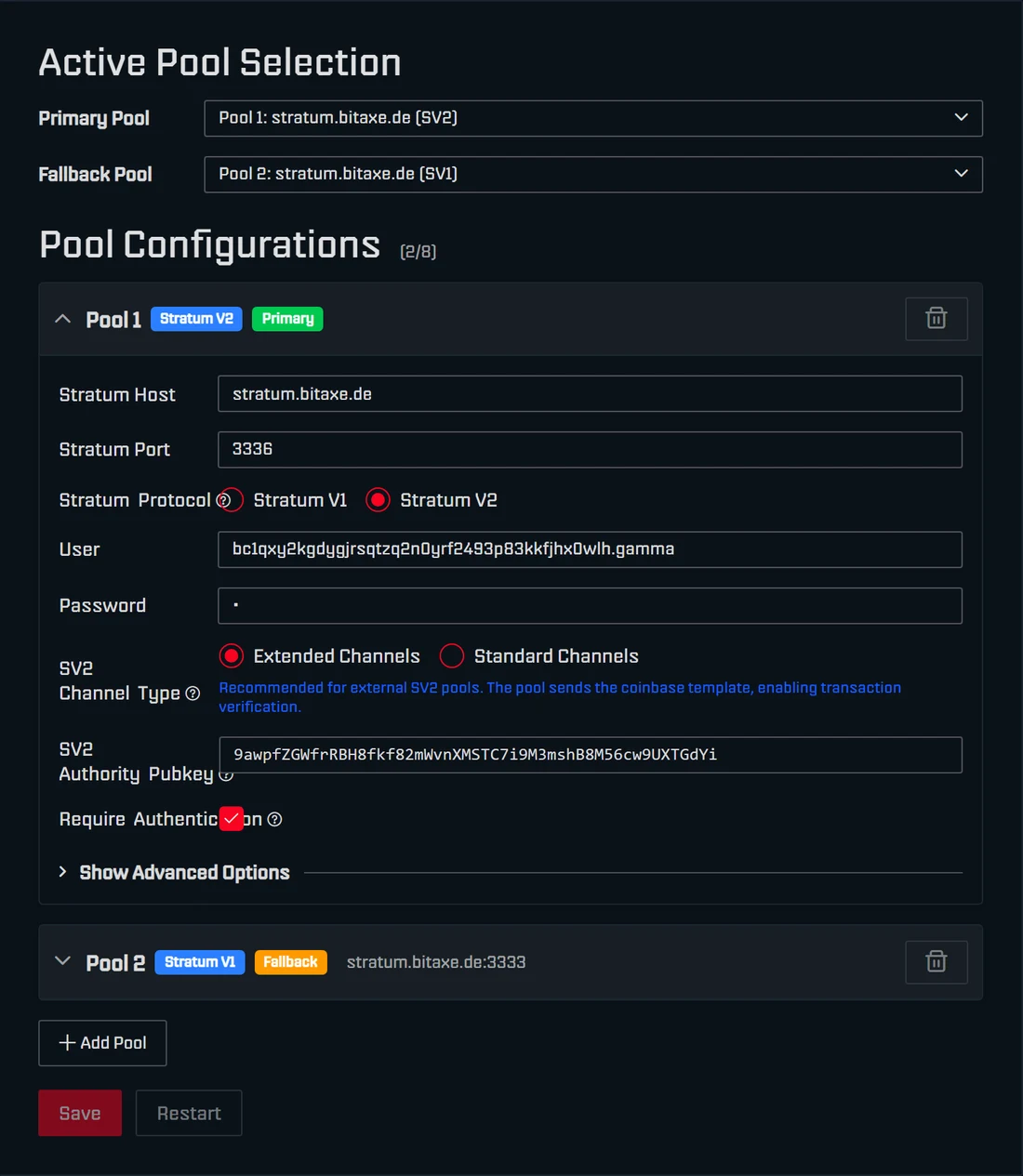
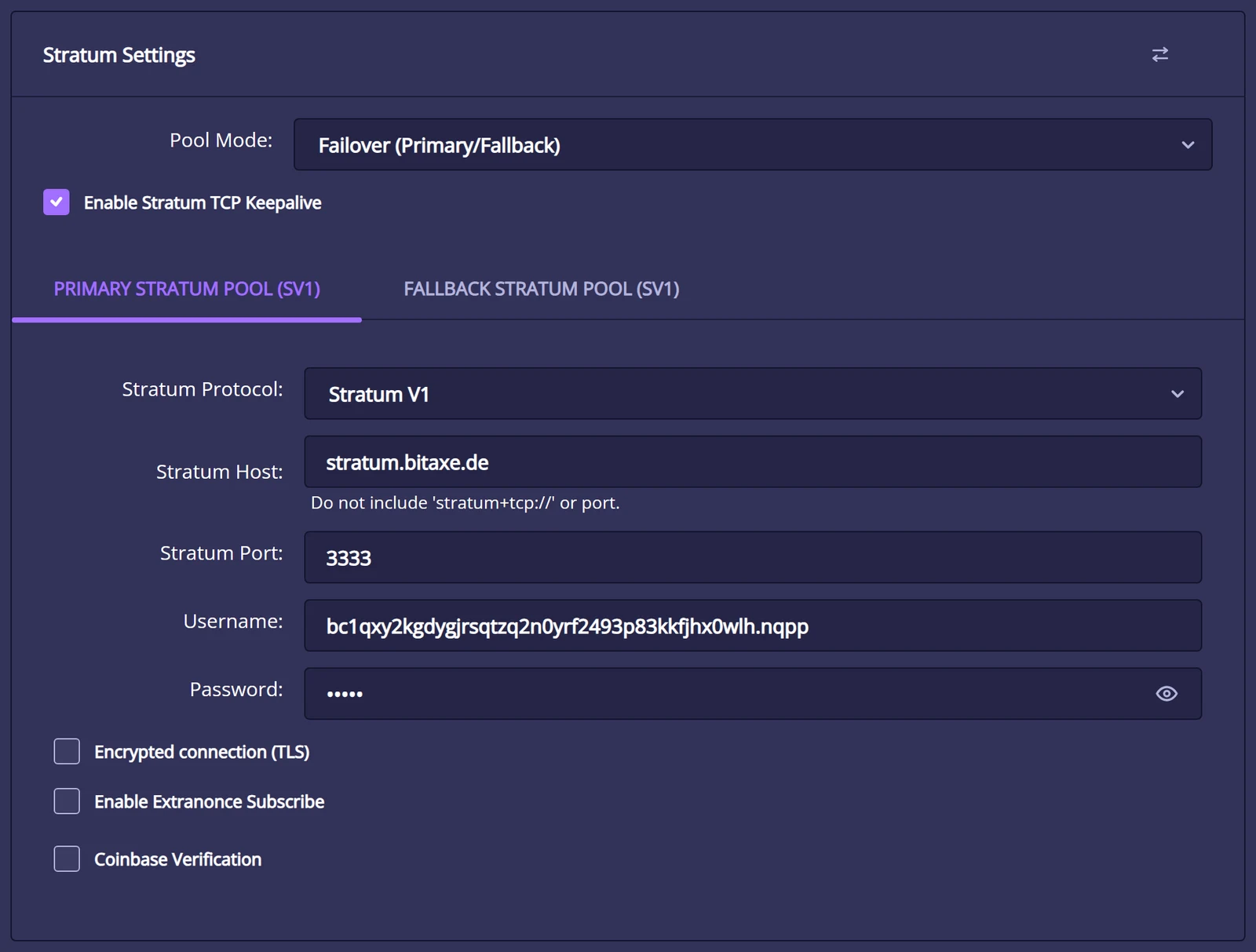
Three differences stand out in everyday use. First, language: AxeOS only speaks English, NerdOS offers nine languages. Second, overheat protection: after overheating AxeOS carries on by itself, but leaves the lowered values and the fan at 100 % until you reset them in Settings; NerdOS halts the miner until you restart it. Third, troubleshooting: AxeOS shows the share of faulty hashes the chip itself reports as “Error”. In NerdOS you compare the hashrate with the “expected” value instead; if it stays below 95 % of that, something is wrong. The AxeOS readouts are explained in AxeOS explained.
Flashing a Nerdaxe with AxeOS does not work: AxeOS only knows Bitaxe boards, and its device table contains no Nerd device. The reverse applies too, NerdOS only runs on Nerd boards. The easiest way to install either is flasher.bitaxe.de. OSM-OS is preselected there, our recommendation with adjusted defaults such as our pool. If you want the unmodified releases, choose “AxeOS original”; on Nerd devices this channel installs the official NerdOS. With “Keep configuration” ticked, Wi-Fi and pool are retained. The steps are in the firmware update guide.
Block odds per model
The chance of a block depends only on hashrate, not on the name on the board. At the difficulty of 26 September 2026 (132.76 T), 1 TH/s finds a block on average once in about 18,000 years. With the expected hashrate out of the box that gives per year:
| Model | Expected out of the box | Chance of a block per year |
|---|---|---|
| Nerdaxe Gamma | 1.05 TH/s (OSM-OS 1.33 TH/s) | 1 in 17,200 (OSM-OS 1 in 13,600) |
| Bitaxe Gamma | 1.07 TH/s | 1 in 16,900 |
| Bitaxe Copperzilla | 1.53 TH/s | 1 in 11,800 |
| Bitaxe GT | 2.14 TH/s | 1 in 8,400 |
| Nerdaxe Gaia | 2.40 TH/s | 1 in 7,500 |
| Bitaxe 702 | 3.75 TH/s | 1 in 4,800 |
| NerdQaxe++ | 4.90 TH/s | 1 in 3,700 |
| NerdQX | 6.34 TH/s | 1 in 2,850 |
| NerdOctaxe | 11.42 TH/s | 1 in 1,600 |
It remains a lottery, even with eight chips. If your miner finds a block, about 3.14 BTC currently go to your address, with no fee on our solo pool pool.bitaxe.de. The mining calculator works out the electricity cost at your tariff, and Bitcoin network shows the current difficulty.
Recommendation by use case
| You want … | Recommendation | Why |
|---|---|---|
| an unobtrusive start with the software of the Bitaxe project | Bitaxe Gamma | smallest device, AxeOS with automatic fan control out of the box, about 17 W |
| to see the values on the device and set it up in your language | Nerdaxe Gamma | the same chip as the Gamma, 1.9-inch colour display, NerdOS in nine languages |
| the best efficiency and a good twice the chance | Nerdaxe Gaia | BM1373 with 2.40 TH/s out of the box at 11 to 12.5 J/TH |
| more out of a single chip | Bitaxe Copperzilla | solid copper heatsink, 750 MHz and 1.53 TH/s out of the box |
| 2 TH/s with AxeOS | Bitaxe GT | two BM1370, 12 V, same handling as the Gamma |
| more than 4 TH/s on a desk | NerdQaxe++ | 4.90 TH/s out of the box at about 76 W, 1.9-inch display |
| as much hashrate per device as possible | NerdOctaxe | eight BM1370, 11.4 TH/s out of the box; as Hydro with water cooling |
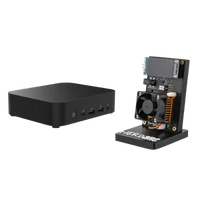
| node and miner from one source | Sovereign Stack | LiquidBox V5 with Umbrel plus Bitaxe Gamma (V1) or Nerdaxe Gamma (V2) |
All devices with current prices, reviews and availability are in the miner comparison. If you already own a Bitaxe and are looking for the next step, the NerdQaxe++ review compares it with the Bitaxe GT and 702.
Conclusion
Bitaxe and Nerdaxe are not competitors but two forms of the same idea with the same choice of chips. In the entry class the decision is about display and firmware: compact with OLED and AxeOS on the Bitaxe Gamma, colour display and NerdOS in nine languages on the Nerdaxe Gamma, at practically the same hashrate. Above that the field splits: the Bitaxe range reaches 3.75 TH/s out of the box with the 702, the Nerd range 11.4 TH/s with the NerdOctaxe, and the Gaia is the most efficient device of all. Setup is covered in Bitaxe setup, Nerdaxe Gamma setup and NerdQaxe++ setup; the right pool is covered in choosing a mining pool.
Frequently asked questions about Bitaxe and Nerdaxe
Is the Bitaxe better than the Nerdaxe?
Is the Nerdaxe the same as the NerdMiner?
Do Bitaxe and Nerdaxe run the same firmware?
Can I flash a Nerdaxe with AxeOS?
Which firmware version is current?
Which is quieter, Bitaxe Gamma or Nerdaxe Gamma?
Does the ICE Tower Kit fit the Nerdaxe Gamma?
Does the Nerdaxe Gaia need a different power supply from the Gamma?
Which model is the most efficient?
Can I run Bitaxe and Nerdaxe together?
stratum.bitaxe.de on port 3333, and the same Bitcoin address with its own name after the dot. On pool.bitaxe.de you then see all devices under your address; the pool configurator creates the values. What are the odds of finding a block with a Bitaxe or Nerdaxe?
Which one should be my first miner?
Matching products


Read more
Nerdaxe Gaia: what the BM1373 miner can do, which firmware to run and who it is for
A single BM1373 in the familiar Nerdaxe format: factory settings from the source code, hashrate and power draw with every documented figure, the 12-volt power supply, OSM-OS from the flasher, setup, overclocking up to the current limit, block odds and electricity cost, plus a comparison with the Nerdaxe Gamma, Bitaxe GT and NerdQaxe++.
Guides & knowledgeSetting up Stratum V2 on a Bitaxe: encrypted solo mining in five fields
Since AxeOS 2.14 every Bitaxe speaks Stratum V2, and since September 2026 so does the Bitaxe Pool. This guide walks through the AxeOS fields one by one, shows how to set up the fallback and verify the connection, and lists what goes wrong when no shares arrive. For Bitaxe, NerdQaxe and large ASICs.
Guides & knowledgeNerdQaxe++ review: 4.8 TH/s from four BM1370, and who should upgrade from a Bitaxe
Four BM1370 on one board, 4.9 TH/s expected out of the box, about 76 W, two fans and NerdOS in the browser: we put the NerdQaxe++ in context. Factory values from the firmware, board revisions, noise, running costs, block odds, setup in NerdOS and the comparison with the Bitaxe Gamma, GT and 702, Copper Pro, Hydro, NerdQX and NerdOctaxe.