
Nerdaxe Gaia: what the new BM1373 miner can do and who should upgrade
14 September 2026 · 16 min read

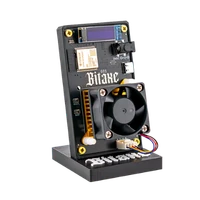
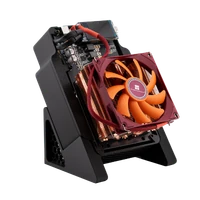
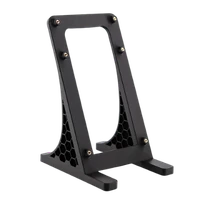
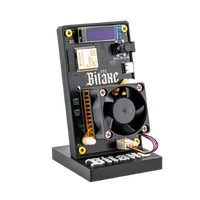
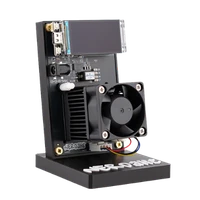
The Nerdaxe Gaia is the first device in the Nerdaxe line with a BM1373, the 3-nanometre chip from Bitmain’s Antminer S23 generation. On the outside almost everything stays the way Nerdaxe owners know it: a board in portrait format, a colour display at the top, a 40 mm fan below it and a stand that keeps the whole thing upright on your desk. Under the fan, though, the most important number has moved. A single chip now delivers more hash rate than two chips of the previous generation, on considerably less power. We went through the manufacturer’s figures, the firmware and the board definition in the source code, and put into context what the Nerdaxe Gaia can do, where its limits are and who should upgrade. The first batch ships from 30 September 2026. We will add our own measurements as soon as the units are here.
stratum.bitaxe.de, port 3333 and your Bitcoin address. Shipping from 30 September. What the Nerdaxe Gaia is
The Gaia comes from BitMaker, the developer of the Nerdaxe line, and is sold primarily through Bitronics in Barcelona. It is the third step in a line that began with a Nerdaxe based on the BM1366 and became a fixture on many desks with the Nerdaxe Gamma and its BM1370. The principle stays the same: a single Bitmain ASIC, an ESP32-S3 as the controller, a display with the operating values and firmware you operate in the browser. No account, no cloud and no software on your PC.
What is new is the power supply. The Bitaxe Gamma and Nerdaxe Gamma run on 5 volts, the Gaia on 12 volts. The firmware expects 10.8 to 13.2 volts at the input. The core is powered by a TPS546D24A voltage regulator that can deliver up to 40 amps. That is far more headroom than the chip needs in normal operation, and it is exactly this headroom that makes higher frequency steps possible in the first place.
| Aspect | Nerdaxe Gaia |
|---|---|
| ASIC | 1 × Bitmain BM1373, 3 nanometres, Antminer S23 generation |
| Hash rate | around 2.4 TH/s on the standard profile (manufacturer figure) |
| Power draw | around 26 W on the standard profile |
| Efficiency | around 11 J/TH |
| Factory setting | 350 MHz frequency, 940 mV core voltage |
| Microcontroller | ESP32-S3 |
| Display | 1.9-inch colour display (LILYGO T-Display S3) with two buttons |
| Cooling | heatsink with 40 mm PWM fan |
| Voltage regulator | TPS546D24A, up to 40 A |
| Power | 12 V, power supply included |
| Wi-Fi | 2.4 GHz |
| Firmware | NerdQ firmware in BitMaker’s branch, based on 1.1.0, Stratum V2 |
| Availability | pre-order, shipping from 30 September 2026 |

The BM1373: why one chip makes the difference
Home Bitcoin miners have used the same chips as the large machines in mining farms for years, just one at a time instead of by the hundred. The Bitaxe Ultra used the BM1366 from the Antminer S19 XP, the Bitaxe Gamma and Nerdaxe Gamma the BM1370 from the Antminer S21 Pro. The BM1373 is the next step. Bitmain uses it in the S23 generation, built on a 3-nanometre process.
Smaller structures mean that each of the billions of transistors in the chip switches at a lower voltage and leaks less current. On a chip that computes without pause, that adds up. The Antminer S23 Hydro, at around 9.5 J/TH, is the first large machine below 10 joules per terahash, and the air-cooled S23 sits at about 11 J/TH. The BM1370 reaches around 14 to 15 J/TH in small miners.
For a home miner this means more hash rate no longer has to come from more chips. The Bitaxe GT gets its 2.15 TH/s from two BM1370 and needs 43 W to do it. The Gaia reaches around 2.4 TH/s at about 26 W on the standard profile with a single BM1373. One chip means a small board, a single fan, less waste heat and a compact power supply.
What the firmware reveals about the chip
How BitMaker runs the chip is written in the board definition of the Gaia firmware, and that is public. From the factory the BM1373 runs at 350 MHz with a core voltage of 940 mV. The selectable range covers frequency steps from 300 to 440 MHz and voltages from 900 to 1,040 mV, and the firmware sets hard limits of 800 and 1,300 mV. The fan controller aims for a chip temperature of 60 °C, and the overheat protection kicks in at 75 °C.
These values are not marketing figures but what the miner actually sets on first start. They also show how cautious the factory setting is: 350 MHz sits in the lower third of the available steps, and 940 mV does too. The Gaia starts out efficient and cool, not at the limit.
Hash rate, power draw and efficiency in context
Different numbers circulate for the Gaia, and they do not contradict each other, they describe different operating points. Bitronics states around 2.4 TH/s at about 26 W for the standard profile, which is around 10.8 J/TH. On the manufacturer photo above, the display shows 2,809 GH/s at 31.3 W, so around 2.8 TH/s at about 11.1 J/TH. The around 2.6 TH/s on our product page sits between these two points.
What stays the same is telling: in both cases the efficiency is around 11 J/TH. With the BM1373, more frequency initially brings almost proportionally more hash rate, without each additional hash becoming noticeably more expensive. That only changes further up, where more voltage is needed and every further hash costs clearly more power and heat. How much an individual unit manages also depends on the chip. Early reports on the BM1373 show clear differences between individual chips, so a number from a forum is no promise for your device.
| Miner | ASIC | Hash rate | Power | Efficiency | Price |
|---|---|---|---|---|---|
| Nerdaxe Gaia | 1 × BM1373 | around 2.4 TH/s | around 26 W | around 11 J/TH | €249.00 |
| Nerdaxe Gamma | 1 × BM1370 | around 1.3 TH/s | around 15 W | around 15 J/TH | €159.00 |
| Bitaxe Gamma | 1 × BM1370 | 1.2 TH/s (measured) | 17 W | around 14 J/TH | €139.00 |
| Bitaxe GT | 2 × BM1370 | 2.15 TH/s | 43 W | around 20 J/TH | €229.00 |
| NerdQaxe++ | 4 × BM1370 | around 4.8 TH/s | around 80 W | around 17 J/TH | €349.00 |
The table shows where the Gaia stands: ahead on efficiency, in the middle on hash rate. It is not the fastest miner in our range, but it is the one that needs the least power per terahash.
Gaia or Nerdaxe Gamma?
This is the obvious question, because both devices look the same, are operated the same way and sit on the same stand. The difference is under the fan. The Gamma works with a BM1370 and around 1.3 TH/s, the Gaia with a BM1373 and around 2.4 TH/s on the standard profile. So you get almost twice the hash rate for around eleven watts more.

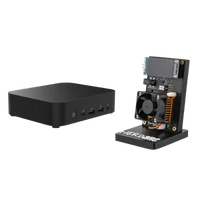
Two things still speak for the Gamma. It is a long-proven device with plenty of experience reports and reviews behind it. And it runs on 5 volts, so on the same power supply as a Bitaxe Gamma. If you already run several 5-volt miners and want to swap power supplies between them, the Gamma keeps logistics simpler.
For everyone else the Gaia is the better choice, because the additional hash rate comes with almost no loss in efficiency. If you want to know how the Nerdaxe family differs from the Bitaxe in general, Bitaxe or Nerdaxe covers it in detail.
Gaia or Bitaxe GT?
The Bitaxe GT is the device the Gaia competes with most directly on hash rate. Both sit between 2 and 2.5 TH/s, and both run on 12 volts. The GT, however, needs two BM1370 and 43 W for it, the Gaia one BM1373 and around 26 W. Over a year that is a difference of around 150 kWh, so at 35 cents per kilowatt hour a good 50 euros, every year, with slightly more hash rate on the Gaia’s side.
What speaks for the GT is that it is a Bitaxe: a reference design from bitaxe.org with AxeOS from the project’s main branch and the largest community behind it. If that is exactly what you want, the GT is the right choice. If you watch your electricity bill and like the larger Nerdaxe display, you are better off with the Gaia.
And the NerdQaxe++?
If hash rate is what you are after, you end up at the NerdQaxe++: four BM1370, around 4.8 TH/s, in exchange for about 80 W and a 92 mm fan. It delivers roughly twice the hash rate of a Gaia but needs a good three times the power. The Gaia is the compact, frugal device for the desk, the NerdQaxe++ the workhorse for the shelf. Which size suits you and when even more chips make sense is covered in detail in the NerdQaxe++ review.
What the higher hash rate means for your block chance
Solo mining works like a lottery with fixed tickets. Every hash is an attempt, and whoever computes more hashes per second draws more tickets. At a difficulty of around 127.45 trillion (as of 14 September 2026), this is how it looks for the devices in the comparison:
| Miner | Hash rate | Chance per day | Chance per year | Expected time to a block |
|---|---|---|---|---|
| Nerdaxe Gaia | 2.4 TH/s | 1 in 2.6 million | 1 in 7,200 | around 7,200 years |
| Nerdaxe Gamma | 1.3 TH/s | 1 in 4.9 million | 1 in 13,300 | around 13,300 years |
| Bitaxe GT | 2.15 TH/s | 1 in 3.0 million | 1 in 8,100 | around 8,100 years |
| NerdQaxe++ | 4.8 TH/s | 1 in 1.3 million | 1 in 3,600 | around 3,600 years |
The numbers look sobering, and they are meant to. The expected time is an average, not an appointment: a block can fall tomorrow or never. What changes is the ratio. The Gaia draws almost twice as many tickets as a Nerdaxe Gamma for only slightly more power. If it finds a block, the whole reward of currently 3.125 BTC plus transaction fees is yours, provided you mine on a solo pool such as the Bitaxe Pool.
The difficulty is expected to rise by around 4 percent with the next adjustment, and the values shift accordingly. The mining calculator works out the current figures for the Gaia. How these probabilities come about and why home miners still find blocks time and again is explained in Bitaxe block probability.
Electricity cost in everyday use
Around 26 W in continuous operation adds up to about 19 kWh a month and around 228 kWh a year. What that costs depends on your tariff:
| Electricity price | per month | per year |
|---|---|---|
| 30 cents per kWh | around €5.70 | around €68 |
| 35 cents per kWh | around €6.65 | around €80 |
| 40 cents per kWh | around €7.60 | around €91 |
At the operating point from the manufacturer photo, around 31 W, it is about 23 kWh a month. Compared with a Nerdaxe Gamma you pay around 34 euros more a year at 35 cents on the standard profile, and compared with a Bitaxe GT you save around 52 euros. If you have a solar installation, you can run the Gaia on your own power for much of the day, since 26 W is a small base load for any system. How to calculate the cost of your whole setup is covered in calculating Bitaxe power consumption.
Cooling, temperature and noise
The BM1373 is cooled by a heatsink with a 40 mm PWM fan whose speed is controlled by an EMC2101 fan controller. The firmware drives the curve with a controller that targets a chip temperature of 60 °C. If the chip gets warmer, the fan speeds up, and if it stays cooler, the fan slows down. The manufacturer photo shows 57 °C at just under 6,800 revolutions per minute. Should the temperature still climb to 75 °C, the firmware’s overheat protection kicks in.
We will only give a noise level in decibels once we have measured the units ourselves. A few things can be said regardless. A 40 mm fan at almost 7,000 revolutions is audible. At 26 W the Gaia gives off a little more heat than a 15 W device, so the fan has a little more work to do. The surroundings matter more than the chip here: in a warm shelf without air exchange any small miner spins up higher than it would standing freely on a desk.
If you want to run the Gaia in a living room or bedroom, you will find the right levers in making a Bitaxe quieter. The article is written for the Bitaxe but carries over, because fan size and control are comparable: a larger or quieter fan, a flatter curve with a slightly higher target temperature and a spot with free air supply.
Power supply: 12 volts instead of 5 volts
The most important practical difference from the Nerdaxe Gamma lies in the power supply. The Gaia runs on 12 volts, the Nerdaxe Gamma and Bitaxe Gamma on 5 volts. The Gaia’s firmware accepts 10.8 to 13.2 volts at the input and does not switch on below 10.5 volts at all. A 5-volt power supply therefore will not get it running. Conversely, a power supply with considerably more than 12 volts, such as a laptop charger, can damage the board.
A matching 12-volt power supply is included, and normally you will not need to replace it. If you do, check the output voltage, sufficient current and the right plug. The firmware allows for up to 6 amps at the input. A power supply that runs at its limit all the time gets warm and delivers an unsteady voltage, which shows up as fluctuating hash rate and more rejected shares. What matters with power supplies in general is explained in which power supply for a Bitaxe.
Firmware: open and with Stratum V2
The Gaia does not run the AxeOS from the Bitaxe project but the NerdQ firmware that shufps originally developed for the NerdQaxe and NerdOctaxe. It shares its roots with AxeOS and is operated the same way in the browser, but brings features of its own. BitMaker maintains its own branch of this firmware with everything the Gaia needs: the board definition, a gold colour scheme for display and dashboard, and the factory settings. The branch is based on NerdQ version 1.1.0 from 29 August 2026.
This gives the Gaia everything the current NerdQ firmware can do from day one. That includes Stratum V2, the encrypted connection to the pool in which the pool has to prove its identity with its authority key, and since 1.1.0 the option to allow authenticated connections only. It includes Dual Pool, mining on two pools at the same time with the firmware splitting the work between them. And it includes the readouts Nerdaxe owners know: hash rate, temperatures, fan speed, voltage, current and power on the display and in the dashboard. How to set up the encrypted connection is shown in setting up Stratum V2 on a Bitaxe, and the fields have the same names in the NerdQ firmware.
What is open and what is still missing
The source code of the Gaia firmware is public on GitHub, under the same GPL-3.0 licence as AxeOS. Anyone can read which values the miner starts with and build the firmware themselves. BitMaker has published the board files, meaning schematic and layout, for the Nerdaxe Gamma in the NerdAxe repository. For the Gaia they are still missing there. As soon as they appear, we will link them here.
Updates
The Gaia ships with ready-to-run firmware, and no update is needed on first start. Later you install new versions through the dashboard. The Gaia is already listed in the web flasher on bitaxe.de, and the image will appear there as soon as an official Gaia release is published. Why you should not update a stably running device without a reason is covered in updating AxeOS on a Bitaxe.
Setup: on the pool in five minutes
The new chip changes nothing about setup. You need a power socket, a 2.4 GHz Wi-Fi network and a Bitcoin address from a wallet whose keys you control yourself.
- Plug in. Connect the power supply. On first start the Gaia opens its own Wi-Fi network for setup.
- Connect to Wi-Fi. Switch to this network with your phone or laptop, choose your home network in the setup portal and enter the password. The Gaia only supports 2.4 GHz. With routers that broadcast both bands under one name, a separate 2.4 GHz network helps during setup.
- Open the dashboard. After the restart the display shows the IP address at the top. Open that address in your browser.
- Enter pool and address. In the pool settings enter host, port and your address, with the values in the table below. Save and restart.
- Check. After one to two minutes the first shares come in. On pool.bitaxe.de your worker appears as soon as you enter your address there.
| Field | Value for the Bitaxe Pool |
|---|---|
| Stratum Host | stratum.bitaxe.de |
| Stratum Port | 3333, with Stratum V2 3336 |
| Stratum User | your Bitcoin address, optionally with a worker name, for example bc1q….gaia |
| Stratum Password | x |
The steps with pictures for the Nerdaxe line are in the Nerdaxe setup guide, and the pool configurator produces the complete data set for your pool. If the miner is on your Wi-Fi but not hashing, Bitaxe connects to Wi-Fi but does not mine walks through the usual causes, and the miner troubleshooter narrows down the fault step by step.
Overclocking: headroom and limits
The firmware gives you room: frequency steps up to 440 MHz and core voltages up to 1,040 mV are selectable. Where the limit lies is shown by a comment in the source code itself. On the Gaia, the default values of the shared voltage regulator driver triggered an over-current shutdown at around 440 MHz and 1 volt, at about 31 amps. BitMaker therefore raised the thresholds for the Gaia to 28 amps for the warning and 33 amps for the shutdown, because the regulator on the board handles 40 amps. At the top end it really does stop, and the firmware was adjusted precisely for that.
In everyday terms this means: go in small steps, watch the error rate and temperature for a few hours after each step, and do not copy values from a forum, because every chip is slightly different. More frequency raises the hash rate, more voltage stabilises higher frequency steps but costs disproportionately more power and heat. A useful rule of thumb: as long as efficiency stays around 11 J/TH, the step is worth it. If it rises clearly above that, each further hash brings little and costs a lot. The overclocking guide describes the procedure in detail. It is written for the Bitaxe but applies to the Gaia just the same, within the limits above.
Pre-order: what you should know
The Gaia is a pre-order item. The first batch ships from 30 September 2026, and if you order now you get a unit from this batch. Until then, patience is required. As soon as the units have arrived here, we will add our own measurements of hash rate, power draw, temperature and noise to this article, so that the figures above do not rest on manufacturer data alone.
Who the Gaia is for and who it is not for
The Gaia suits you if you want to stay with the Nerdaxe format and almost double your hash rate without changing device class. It suits you if power per terahash matters more to you than the last bit of hash rate, and you are looking for a miner that should run permanently on a desk or shelf. As a second device next to a Bitaxe or Nerdaxe Gamma it complements an existing setup well, because operation and pool settings are the same.
It is less suitable if you want to mine today and do not want to wait until the end of September. It is also not the right choice if maximum hash rate is your main goal, where the NerdQaxe++ or NerdOctaxe are the right class. And if you specifically want a reference design from bitaxe.org with AxeOS from the main branch, go for the Bitaxe Gamma or the Bitaxe GT.
Conclusion
The Nerdaxe Gaia is not a jump in size but one in efficiency. A single BM1373 achieves almost twice the hash rate of a Nerdaxe Gamma in the familiar format, and more than a Bitaxe GT, on considerably less power than the GT. The firmware is open, brings Stratum V2 and Dual Pool and starts with cautiously chosen factory settings. Still open are the board files and our own measurements.
If you are looking for a frugal, compact solo miner with a real step up in performance and can wait until the end of September, the Gaia gives you the most efficient device in our range. The chance of a block stays small, as with any home miner. But every hash counts in full, and with the Gaia every hash costs less power than with any other miner we offer.
When does the Nerdaxe Gaia ship?
Which chip is inside the Nerdaxe Gaia?
How much hash rate does the Nerdaxe Gaia deliver?
How much power does the Nerdaxe Gaia use?
Which power supply does the Nerdaxe Gaia need?
What is the difference between the Nerdaxe Gaia and the Nerdaxe Gamma?
Nerdaxe Gaia or Bitaxe GT?
Does the Nerdaxe Gaia run AxeOS?
Does the Nerdaxe Gaia support Stratum V2?
3336 for it, and the guide is in setting up Stratum V2 on a Bitaxe. Is the Nerdaxe Gaia open source?
How loud is the Nerdaxe Gaia?
Can I overclock the Nerdaxe Gaia?
Why is a pool already set on first start?
Matching products


Read more
Setting up Stratum V2 on a Bitaxe: encrypted solo mining in five fields
Since AxeOS 2.14 every Bitaxe speaks Stratum V2, and since September 2026 so does the Bitaxe Pool. This guide walks through the AxeOS fields one by one, shows how to set up the fallback and verify the connection, and lists what goes wrong when the pool stays red. For Bitaxe, NerdQaxe and large ASICs.
Guides & knowledgeNerdQaxe++ review: 4.8 TH/s from four BM1370 – is it worth upgrading from a Bitaxe?
Four BM1370 ASICs on one board, around 4.8 TH/s at roughly 80 W, a 92 mm fan and AxeOS in the browser: we place the NerdQaxe++ against the Bitaxe Gamma, Nerdaxe Gaia, NerdQaxe++ Hydro, Copper Pro, NerdQX and NerdOctaxe – with efficiency, noise, block odds and a clear recommendation for whom it is the right size.
Guides & knowledgeSetting up the Bitaxe Gamma 601: a step-by-step guide to the first start
Setting up the Bitaxe Gamma 601: a precise step-by-step guide to Wi-Fi, AxeOS, pool settings, your Bitcoin address, monitoring, common mistakes and sensible next steps.