
Bitcoin Mining Calculator
Power cost, solo block chance and expected value – honestly calculated for Bitaxe, NerdQaxe & Co. Pick a miner or enter your own numbers.
Your setup
Network hashrate and BTC price are pulled live from mempool.space · as of 05.10.2026 15:06. Both fields stay editable.
Results
- Power cost
- –
- –
- Solo chance per day
- –
- –
- Chance ≥1 block
- –
- –
- Expected value / month
- –
- –
Honest note: solo mining is a lottery, not an investment. The expected value is a statistical average – in reality you win rarely, but then a whole block at once.
Odds of mining a Bitcoin block solo
Every block is a draw. Your chance of winning a single draw equals your share of the network: your hashrate divided by the network hashrate. Over many blocks the draws add up. With p as your chance per block, the chance of at least one block in n blocks is 1 − (1 − p)n. A day has about 144 blocks, a year about 52,560.
The table uses the same network hashrate as the calculator above (963 EH/s, live from mempool.space). The device values are the factory hashrates from our product pages.
| Miner | Hashrate | Per block | Per day | Per year | Average wait |
|---|---|---|---|---|---|
| Bitaxe Gamma | 1.3 TH/s | 1 in 740,000,000 | 1 in 5,100,000 | 1 in 14,000 | 14,000 years |
| Bitaxe GT | 2.15 TH/s | 1 in 450,000,000 | 1 in 3,100,000 | 1 in 8,500 | 8,500 years |
| Nerdaxe Gaia | 2.6 TH/s | 1 in 370,000,000 | 1 in 2,600,000 | 1 in 7,000 | 7,000 years |
| NerdQaxe++ | 4.8 TH/s | 1 in 200,000,000 | 1 in 1,400,000 | 1 in 3,800 | 3,800 years |
| NerdQX | 8 TH/s | 1 in 120,000,000 | 1 in 840,000 | 1 in 2,300 | 2,300 years |
| NerdOctaxe | 12 TH/s | 1 in 80,000,000 | 1 in 560,000 | 1 in 1,500 | 1,500 years |
The average wait is a statistical mean, not a countdown. The odds are the same every ten minutes: a miner that has been running for two years is not “due” for a block, and a block can land in the first week. That is why home solo mining is often called lottery mining. Chance scales linearly with hashrate, so four Bitaxe Gammas have about the same odds as one NerdQaxe++.
Why people solo mine anyway
The network draws a winner about every ten minutes, 144 times a day, and small miners do win from time to time. If one does, the whole block reward of 3.125 BTC plus fees goes to the address in the miner, with no pool in between. Real Bitaxe blocks and what happens after a find are in Finding a block with a Bitaxe: what are the odds, really?. How solo and pool mining compare is explained in the solo mining guide.
Power cost matters more than hashrate
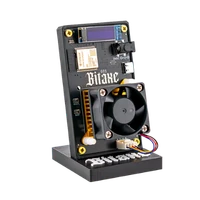
Open-source miners like the Bitaxe Gamma draw 15 to 20 watts, less than a router. Even at 30 ct/kWh that is only around €4 per month. Larger models like the NerdQaxe++ (about 80 W) or NerdOctaxe (about 200 W) multiply your chance while staying far below the cost of classic ASIC miners.
Frequently asked questions
How realistic is finding a solo block?
+
Solo mining is a lottery: your chance per block equals your share of the total network hashrate. A Bitaxe Gamma at factory settings (about 1.07 TH/s) currently has odds of about 1 in 17,000 per year. But every ten minutes or so there is a new draw, and someone with small hardware does win from time to time; five solo blocks by Bitaxes are documented.
What does the expected value mean?
+
It is the statistical average: block chance × block reward × Bitcoin price. In solo mining you almost always earn nothing for a long time – and then possibly a whole block (currently 3.125 BTC plus fees) at once.
Which numbers should I enter for network hashrate and BTC price?
+
Both change daily. The calculator uses editable defaults – simply enter the current network hashrate (in EH/s) and BTC price for a precise result.
Pool or solo?
+
A pool pays tiny amounts steadily, solo pays extremely rarely but everything at once. Most home miners run solo (lottery) because with small hashrate the pool payout barely covers the fun anyway.
How is the chance of solo mining a block calculated?
+
Per block, your chance is your hashrate divided by the network hashrate. For a longer period it is 1 − (1 − p)^n, with n = 144 blocks per day or about 52,560 per year. A Bitaxe Gamma with 1.3 TH/s at a network of about 1,000 EH/s has roughly 1 in 770 million per block, 1 in 5 million per day and 1 in 15,000 per year. The table on this page calculates it with the live network hashrate.
Does a high best difficulty mean I am close to a block?
+
No. Every share is an independent draw and nothing accumulates. Best difficulty only shows the luckiest share your miner has found so far. A block needs a share above the current network difficulty, which our Bitcoin network page shows. A miner that once came close has exactly the same chance on its next share as one that never did.