
Bitaxe Pool: solo mining from Frankfurt with 0 % fee, SOLO groups and Stratum V2
8 September 2026 · 11 min read · Updated on 26 September 2026

Once a Bitaxe has Wi-Fi and a Bitcoin address, exactly one decision determines everything that follows: the pool. Over two years of support we have talked this decision through with customers hundreds of times, and at some point decided to run the pool we could recommend with a clear conscience ourselves. The result is the Bitaxe Pool: a ckpool-based solo mining pool with its server in Frankfurt, no fee, no account, and since 8 September 2026 Stratum V2. This article explains what the pool does differently from Public Pool and Solo CKPool, who it suits, how to set it up in three minutes, and what SOLO groups and Stratum V2 are about.
stratum.bitaxe.de, Stratum Port 3333, User your Bitcoin address, Password x, then Save and Restart. Stratum V2 on port 3336 with the authority key 9awpfZGWfrRBH8fkf82mWvnXMSTC7i9M3mshB8M56cw9UXTGdYi (AxeOS 2.14 or newer, NerdOS 1.0.37 or newer). The pool configurator builds the values ready to copy; pool.bitaxe.de shows the statistics for your address. What the Bitaxe Pool is, and what it is not
A solo pool does the work for your miner that a Bitcoin node at home would otherwise have to do: it keeps the blockchain current, builds block templates from the mempool and distributes them to the connected devices via stratum. The decisive difference from a regular pool sits inside the block template itself: it already contains your Bitcoin address as the recipient of the coinbase transaction. If your miner finds a valid block, the block writes the entire reward, currently 3.125 BTC plus transaction fees, straight to that address. The pool never holds a balance, there is no payout threshold, no account and nothing that could be lost.
What the Bitaxe Pool is not: a pool with a steady trickle of micro-payouts. If you would rather collect a few satoshis a day with a Bitaxe, OCEAN or Braiins are the places to go. Why that stays below your electricity cost at 1 to 5 TH/s is worked out in Choosing a Bitaxe mining pool. Solo mining is the choice for everyone who wants the full chance at the whole block, and that is exactly what the pool is built for.
Six reasons to choose the Bitaxe Pool
- 0 % fee. Solo CKPool keeps 2 % of a found block. At around 3.14 BTC per block today that is a good 0.06 BTC. On the Bitaxe Pool the coinbase transaction goes entirely to your address. Only SOLO groups cost 1 %, because the shared payout needs operation and bookkeeping.
- Server in Frankfurt. From Germany, Austria and Switzerland the path is short, instead of crossing the Atlantic to a server in the US. Shorter paths mean new block templates arrive sooner, your miner works less often on a stale template, and fewer shares get rejected. AxeOS shows how fast your pool answers in the Pool card under “Time”.
- Start difficulty 1,000 with automatic adjustment. A Bitaxe Gamma then sends a share every three to four seconds on average, even without setting a suggested difficulty yourself. The dashboard shows right away that it is running, and the statistics become meaningful quickly.
- Statistics without a login. No account, no email: the pool only knows you by your address. Enter your address, done: hash rate, workers, shares and best difficulty per device, plus a leaderboard for the current month and all time. It works on a phone just as well as on a desktop.
- SOLO groups. Play for a block with friends, family or the community under a shared
#tag. The same coinbase transaction splits the payout proportionally, without anyone holding other people’s coins. - Support from people who know the devices. If something does not work, the same support team that sets up Bitaxe, Nerdaxe and NerdQaxe every day helps, with the troubleshooter as the first step.
New: Stratum V2
Stratum is the protocol miners and pools use to talk to each other. The first version dates from 2012 and sends everything across the network as readable text: block templates, shares, your address. Anyone sitting on the path, in the Wi-Fi, in the router or at the provider, can read along and in principle interfere. The best-known attack is hash rate hijacking: a man-in-the-middle swaps the template, and your miner works for a stranger’s address without you seeing it in the dashboard.
Stratum V2 closes exactly this gap. The connection is encrypted with the Noise protocol, and the pool identifies itself with its authority public key: when connecting, your miner verifies that it is really talking to the Bitaxe Pool and not to someone who has inserted themselves in between. On top of that the protocol is binary rather than text-based, so it needs less bandwidth, and job distribution is defined more cleanly than in V1. Stratum V2 changes nothing about your chance of a block. It is about the security and cleanliness of the connection, not about more hash rate.
Two things we deliberately do not offer: with us the pool builds the block templates, not the miner (“job declaration”). If you want your own templates, your own node serves you better. That is what it is for, and Connecting a Bitaxe to your own Bitcoin node shows how. And Stratum V1 remains available in parallel: if you do not want to change anything, you do not have to.
The prerequisite is firmware that speaks V2: AxeOS 2.14.0 or newer (June 2026) on all Bitaxe devices, NerdOS 1.0.37 or newer on NerdQaxe, NerdQaxe+, NerdQaxe++, NerdOctaxe and Nerdaxe Gamma; the current versions are AxeOS 2.15.3 and NerdOS 1.1.0.1. An older device is brought up to date in the browser with the Bitaxe Flasher, which preselects OSM-OS, our recommendation; how an update runs safely is covered in AxeOS firmware update. The values side by side:
| Field | Stratum V1 | Stratum V2 |
|---|---|---|
| Host | stratum.bitaxe.de | stratum.bitaxe.de |
| Port | 3333 | 3336 |
| Port for large ASICs (high diff) | 4334 | 4336 |
| Authority public key | none | 9awpfZGWfrRBH8fkf82mWvnXMSTC7i9M3mshB8M56cw9UXTGdYi |
| User | Bitcoin address, optionally .worker and #group | identical |
| Password | x | not used |
| Full URL | stratum+tcp://stratum.bitaxe.de:3333 | stratum2+tcp://stratum.bitaxe.de:3336/9awpf…UXTGdYi |
In AxeOS, open the Pool page from the menu, set the pool’s Stratum Protocol to Stratum V2, enter Stratum Host, Stratum Port 3336 and the SV2 Authority Pubkey, leave the SV2 Channel Type on Extended Channels and tick Require Authentication. Then Save and Restart. After one to two minutes the Pool card on the dashboard shows “SV2 Extended Channel” under “Mode”. Address, worker name and SOLO groups work over V2 exactly as over V1. A sensible layout is V2 as the primary pool and V1 on port 3333 as the fallback pool: AxeOS then switches on its own if the V2 connection fails and returns once it is back. The pool configurator produces the complete data set including the finished V2 URL in step 3. Field by field, with fallback, verification and failure patterns, it is all in setting up Stratum V2 on a Bitaxe.
SOLO groups: playing for the block together
A single Bitaxe is a lottery ticket with a full payout, and some people would rather share several tickets with others. That is exactly what SOLO groups are: you append a #groupname to your worker name, for example bc1q….gamma1#friends. All miners with the same tag automatically form a group, with no registration and without anyone having to know the others’ addresses. If a member finds a block, the coinbase transaction contains one output per member, proportional to the work submitted, plus 1 % for the pool. The payout stays on-chain and non-custodial; nobody holds other people’s coins in between.
Up to 50 wallets fit in one group. Public groups appear in the list on pool.bitaxe.de so that others can join; if you want to stay among yourselves, append .hidden. #family.hidden is fully functional but appears in no list. Your own devices can be bundled the same way: three Bitaxe and one NerdQaxe under one tag count their work together. Calculated honestly, a group does not change the expected value. Minus the one percent it stays the same, but it makes hits more frequent and smaller. For many that is the more pleasant way to take part.
New: Ranks & Rewards, points for every terahash hour
Since September 2026 the Bitaxe Pool keeps count of what your miner delivers: 3.6 points per TH/s and day, credited every five minutes, up to 15 TH/s per address, no account, no sign-up. The points belong to the Bitcoin address your miner uses. A Bitaxe Gamma collects about four points a day, a NerdQaxe++ about seventeen.
On top come ranks that grow with time in the pool, not with hashrate. Counting happens in difficulty epochs of 2016 blocks, about two weeks; an epoch counts once your miner ran on at least seven of its days. A rank is never lost; it is your badge for time in the pool. The points bonus comes from your streak: mining days in a row earns ×1.05 from 31 days and ×1.10 from 90 days, and a full day without hashrate resets the streak.
| Rank | active epochs |
|---|---|
| Nonce | 0 |
| Hasher | from 1 (about two weeks) |
| Miner | from 6 (a quarter) |
| Veteran | from 13 (half a year) |
| Old Guard | from 26 (a year) |
| Legend | from 52 (two years) |
A SOLO group adds a little for every member: ×1.02 from five counting wallets (Crew), ×1.04 from ten (Squad), ×1.06 from 20 (Fleet), ×1.08 from 30 (Armada) and ×1.10 from 45 (Mothership). Whoever finds a block becomes a Block Finder and receives 10,000 points. The leaderboards on pool.bitaxe.de show each miner’s rank; the Ranks & Rewards page shows the whole ladder and how many miners hold each rank.
Redeeming happens here in the shop: at bitaxe.de/en/rewards you enter your address, see your balance and turn 500 points or more into a discount code once you have 30 active days. 100 points are 1 euro; a code covers at most 10 percent of an order and lasts 30 days, each e-mail can redeem up to 50 euros a month, and whatever a code does not use returns as points. No cash value, no payout, no balance held for you: it is a loyalty programme with the maths in the open, and the terms are on that page.
Bitaxe Pool, Public Pool, Solo CKPool or your own node?
All four routes are real solo mining with payout via the coinbase transaction. They differ in fee, location, features and what you have to run yourself. Stratum V2 is not a unique selling point: Solo CKPool offers it too, and Public Pool is testing it with a temporary key.
| Bitaxe Pool | Public Pool | Solo CKPool (EU) | Public Pool on your own node | |
|---|---|---|---|---|
| Fee | 0 % (SOLO groups 1 %) | 0 % | 2 % of the block | 0 % |
| Location | Frankfurt | distributed worldwide | Germany, USA and Australia, chosen automatically | your home |
| Stratum V2 | yes, port 3336 | in trial operation, port 23330 | yes, port 3336 | depends on version |
| SOLO groups | yes | no | no | no |
| Start difficulty | 1,000, adjusted automatically | automatic | from 10,000, lower via suggested difficulty | configurable |
| Statistics | no login, leaderboard, groups, rewards | no login | no login | local |
| Own node required | no | no | no | yes, including maintenance |
| Support | Bitaxe.de | community (Discord) | the operator’s forum thread (Bitcointalk) | community |
Public Pool is the pool preconfigured in AxeOS from the factory and technically a solid solo pool. The difference to us lies in location, groups and support. Solo CKPool has the longest block history of all solo pools, more than 300 blocks since 2014, but takes 2 % of a find. Your own node is the route for everyone who wants maximum independence and is prepared to take responsibility for storage, updates and uptime. Whether that is worth it is covered in Running your own Bitcoin node. A tip for node operators: enter the Bitaxe Pool on the AxeOS Pool page as the fallback pool. When the node reindexes, needs an update or the NAS is asleep, the miner keeps hashing instead of waiting for hours.
Three steps onto the Bitaxe Pool
- Open AxeOS. The IP address of your miner is on the display or in your router’s device list; since AxeOS 2.15
http://bitaxe.localworks too. Open it in the browser, then Pool in the menu on the left. - Enter the pool. For the primary pool: Stratum Host
stratum.bitaxe.de(withoutstratum+tcp://and without a port), Stratum Port3333, Stratum Protocol Stratum V1, User your Bitcoin address with an optional worker name, for examplebc1q….gamma1, Passwordx. If the User field still holds someone else’s address, replace it: AxeOS shows a yellow warning for the factory address, and on OSM-OS the Bitaxe Pool is already entered, but the user is not yours. - Save and check. Save, then Restart; AxeOS only applies pool changes after the restart. After one to two minutes the dashboard shows accepted shares and “Best Difficulty” starts climbing. On pool.bitaxe.de, enter your address in the search field and you will see the worker with its hash rate. So you notice if it drops out later, @bitaxepool_bot reports silent workers via Telegram; more on monitoring in monitoring a Bitaxe.
On NerdQaxe, NerdOctaxe and Nerdaxe Gamma the same values go into NerdOS under Settings, in the “Stratum Settings” card (Stratum Host, Stratum Port, Username, Password). Several devices each get their own worker name after the dot and still run on one address; the statistics keep them apart, a found block pays to the same wallet. Large ASICs such as Antminer or Whatsminer belong on the high-difficulty port 4334 (V2: 4336), because the standard difficulty would be too low for their output. If the miner runs but delivers no shares, the troubleshooter gets you to the cause in three clicks; the most common cases are explained in Bitaxe connected to Wi-Fi but not mining. The complete first-time setup from unboxing to the first share is described in Setting up the Bitaxe Gamma.
Three more sentences on the address, because this is where the most expensive mistakes happen: use an address from a wallet whose keys you control yourself, not an exchange address that may be invalid tomorrow, and not a Lightning address, because the coinbase pays on-chain. Copy the address, never type it; one character off and you are mining for a stranger. And allow for freshly mined coins only becoming spendable after 100 blocks, a good 16 hours. That is a rule of the Bitcoin protocol, not of the pool.
Which miner suits the Bitaxe Pool?
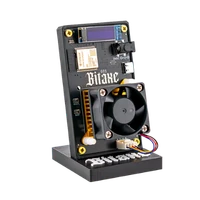
Any SHA-256 miner with stratum. For getting started, the Bitaxe Gamma is the right choice: about 1.1 to 1.2 TH/s at around 17 W, quiet, runs on the included 5 V power supply. If you want more tickets per wall socket, take the NerdQaxe++ with four BM1370 or go straight to the NerdOctaxe with eight. Both speak Stratum V2 with NerdOS 1.0.37 or newer. Prices are live on the product pages; the table pulls them from the catalogue.
| Model | Chips | Factory hash rate | Stratum V2 | Price |
|---|---|---|---|---|
| Bitaxe Gamma | 1 × BM1370 | about 1.1 TH/s (AxeOS expects 1.07 TH/s) | AxeOS 2.14+ | from €139.00 |
| Nerdaxe Gamma | 1 × BM1370 | about 1.1 TH/s on NerdOS, about 1.3 TH/s on OSM-OS | NerdOS 1.0.37+ | €159.00 |
| NerdQaxe++ | 4 × BM1370 | about 4.9 TH/s | NerdOS 1.0.37+ | €349.00 |
| NerdOctaxe | 8 × BM1370 | about 11.4 TH/s (revision 3 onwards) | NerdOS 1.0.37+ | €699.00 |
How big the chance really is per model, the mining calculator works out with the current difficulty, and Finding a block with a Bitaxe explains why the answer for a single Bitaxe is “more than 10,000 years on average” and solo miners still hit every year. The miner comparison shows all devices side by side, the buying guide puts them in context.
Calculated honestly: what the pool promises, and what it does not
A solo pool promises no blocks. It promises that every hash of your miner is a real chance at the whole block, and that a hit lands with you completely, verifiably and without detours. The chance itself depends solely on your hash rate and the network difficulty. No pool in the world can raise it, and anyone who claims otherwise is selling something else. What makes solo mining real all the same: according to mempool.space, pure solo pools found 16 blocks in 2026 up to the end of September (Solo CKPool 6, Public Pool 5, Braiins Solo 4, Noderunners 1). In July a single Bitaxe Gamma at about 1 TH/s hit (block 957,382), in April a NerdOctaxe and a NerdQaxe++. The current figures come live from mempool.space and are shown on the pool’s front page, just like the blocks of the Bitaxe Pool itself. Nothing appears there that the blockchain does not confirm.
So if you buy a Bitaxe, buy it for what it is: a quiet, frugal full participant in the Bitcoin network with a lottery ticket that never expires. The Bitaxe Pool makes sure that ticket runs in your name. The values are above, or ready to copy in the pool configurator.
What is the Bitaxe Pool?
What does the Bitaxe Pool cost?
Which values do I enter in AxeOS?
stratum.bitaxe.de (without prefix and port), Stratum Port 3333, User your Bitcoin address with an optional .workername, Password x, then Save and Restart. For Stratum V2: Stratum Protocol Stratum V2, port 3336, SV2 Authority Pubkey 9awpfZGWfrRBH8fkf82mWvnXMSTC7i9M3mshB8M56cw9UXTGdYi, SV2 Channel Type Extended Channels, Require Authentication on. Do I need Stratum V2?
Which firmware do I need for Stratum V2?
How do SOLO groups work?
#tag to your worker name, for example bc1q….gamma1#friends. All miners with the same tag automatically form a group. If the group finds a block, the coinbase transaction contains one output per member, proportional to the work submitted, plus a 1 % pool fee. A maximum of 50 wallets per group; with the suffix .hidden the group stays out of the public list. What happens when my miner finds a block?
Can I run an Antminer or Whatsminer on the Bitaxe Pool?
4334 (Stratum V2: 4336), because the standard difficulty would be too low for their output. Bitaxe, Nerdaxe and NerdQaxe stay on 3333 or 3336. Can I use the Bitaxe Pool as a fallback pool?
Where do I see my statistics?
What are Bitaxe Rewards?
How do I redeem reward points?
Matching products


Read more
Finding a block with a Bitaxe: what are the odds, really?
A Bitaxe Gamma finds a block with odds of 1 in 16,900 per year. Here is the full math with current network data: odds per hashrate, the effect of difficulty, what Best Difficulty really shows, which Bitaxes have already found blocks and what happens if you hit.
Bitcoin miningOverclocking a Bitaxe: AxeOS 2.15 guide with measured values and limits
How to unlock overclock mode in AxeOS 2.15, which steps to take, what others have measured with the Gamma, GT and NerdQaxe++, and where temperature, power supply and voltage regulator draw the line. Every limit checked in the firmware source code.
Guides & knowledgeMonitoring a Bitaxe: catch outages, heat and wrong payouts without false alarms
Which values the AxeOS API really delivers, when “no share for …” is a real outage, why a Bitaxe runs slower for good after overheating, and how a small script on your home network watches heat, power, fallback pool and coinbase.