
Finding a block with a Bitaxe: what are the odds, really?
20 August 2026 · 13 min read · Updated on 26 September 2026

On 10 July 2026 a single Bitaxe with just under 1 TH/s found Bitcoin block 957,382. It ran on the public-pool.io pool, and the entire reward of 3.138 BTC went to its address, about 200,000 US dollars at the time. It was the fifth known solo block of a Bitaxe. Hits like that are rare, but they happen, and they raise the question everyone with a Bitaxe on the desk asks sooner or later: how likely is that for my device?
The question has an exact answer. We work it out here with the network data of 26 September 2026, for every size from the Gamma to the big home miners, with the real blocks of recent years and without exaggerating in either direction.
How to calculate the odds
Bitcoin mining is a fair lottery. Every hash is a ticket, and a ticket wins if the hash is smaller than a target the network resets every 2,016 blocks. That target is expressed as the difficulty. It tells you directly how many hashes a block takes on average: difficulty times 232. On 26 September 2026 the difficulty was 132.76 trillion, so a block takes 5.7 · 1023 hashes on average.
Divide that number by your miner's hashrate and you get the expected time to a block. For the Gamma at 1.07 · 1012 hashes per second that is 5.3 · 1011 seconds, about 16,900 years. The chance of finding at least one block within a time t is 1 − e−t / expected time; for short periods that is practically t divided by the expected time. One year out of 16,900 years gives 1 in 16,900.
| Network data | As of 26.09.2026 |
|---|---|
| Difficulty | 132.76 T (since 19.09.2026) |
| Network hashrate | about 920 EH/s |
| Reward per block | 3.125 BTC plus 0.0195 BTC in fees on average, together 3.1445 BTC |
| Value of a block | about 232,000 euros (73,876 euros per BTC) |
| Next adjustment | early October 2026, estimated at about −3 % |
The odds depend only on the difficulty, not directly on how many other miners there are. Our network dashboard shows the current values, and the mining calculator works out your personal odds with live data.
Odds by hashrate
The odds grow exactly in proportion to the hashrate: double the hashrate means double the chance, with no threshold and no minimum stake. That is why a few steps are enough to place any device:
| Hashrate | Example | Per day | Per year | In 10 years | Expected time |
|---|---|---|---|---|---|
| 1.07 TH/s | Bitaxe Gamma at factory settings | 1 : 6.2 m | 1 : 16,900 | 1 : 1,690 | 16,900 years |
| 2.14 TH/s | Bitaxe GT 801 | 1 : 3.1 m | 1 : 8,400 | 1 : 845 | 8,400 years |
| 4.9 TH/s | NerdQaxe++ | 1 : 1.3 m | 1 : 3,700 | 1 : 370 | 3,700 years |
| 10 TH/s | NerdOctaxe class | 1 : 660,000 | 1 : 1,800 | 1 : 180 | 1,800 years |
| 100 TH/s | about 100 Gammas or one large ASIC | 1 : 66,000 | 1 : 181 | 1 : 19 | 181 years |
Two things stand out. First, even a large home device remains a lottery ticket: at 10 TH/s the expected time is still about 1,800 years. Second, the “expected time” is an average, not a waiting time. A hit can come tomorrow or never; 63 % of all hits come earlier than the average, 37 % later. That is exactly why the lucky cases you read about exist.
How the difficulty affects the odds
The difficulty adjusts every two weeks to the computing power of the network. If it rises, your odds drop; if it falls, they rise. Over the last three years it rose by 33 % per year on average, but over the last twelve months it fell by 6.7 %. This is how that changes the odds of a Gamma at 1.07 TH/s:
| Difficulty per year | In 1 year | In 5 years | In 10 years |
|---|---|---|---|
| −6.7 % (like the last 12 months) | 1 : 16,400 | 1 : 2,800 | 1 : 1,170 |
| unchanged | 1 : 16,900 | 1 : 3,400 | 1 : 1,690 |
| +30 % (roughly the average since 2023) | 1 : 19,200 | 1 : 6,100 | 1 : 4,800 |
| +50 % (like 2023 to 2025) | 1 : 20,400 | 1 : 7,900 | 1 : 6,900 |
If the difficulty keeps rising, every further year is worth less, because the same hashrate delivers an ever smaller share. The next halving, expected in 2028 at block 1,050,000, halves the block subsidy to 1.5625 BTC. It does not change the odds, only the value of a hit.
Real blocks from Bitaxes and other home miners
Which device found a block is never recorded in the blockchain. The attribution comes from pool logs; for the solo service solo.ckpool.org its operator publishes address, worker and hashrate for every block. These blocks by Bitaxe-class devices are documented:
| Block | Date | Pool | Device | Reward |
|---|---|---|---|---|
| 853,742 | 24.07.2024 | solo.ckpool.org | first Bitaxe block, address with 3.1 TH/s | 3.192 BTC |
| 887,212 | 10.03.2025 | solo.ckpool.org | Bitaxe Ultra with about 480 GH/s | 3.150 BTC |
| 888,989 | 23.03.2025 | Public Pool on Umbrel | Bitaxe on its own node | 3.152 BTC |
| 924,569 | 21.11.2025 | solo.ckpool.org | Bitaxe Gamma with 1.26 TH/s (one of six) | 3.146 BTC |
| 943,466 | 03.04.2026 | public-pool.io | NerdOctaxe | 3.148 BTC |
| 944,078 | 07.04.2026 | Noderunners pool | NerdQaxe++ with about 4.8 TH/s | 3.132 BTC |
| 957,382 | 10.07.2026 | public-pool.io | single Bitaxe with about 1 TH/s | 3.138 BTC |
Five of these blocks come from Bitaxes, two from devices of the Nerd series. That it keeps hitting despite the tiny individual odds is down to sheer numbers: public-pool.io alone counts more than 25,000 connected miners with about 50 PH/s together. At that hashrate, two to three hits per year are statistically expected, somewhere, for someone.
Be careful with lists on the web: several alleged Bitaxe blocks are misattributed. According to the pool log, block 889,975 came from an address with 2.43 PH/s and block 903,883 from 2.3 PH/s, and block 913,272 on the OCEAN pool was found by a NerdQaxe++, but the reward was split among 17 participants. That was not a solo block in the proper sense.
Best Difficulty: what it shows and what it does not
Every hash has its own difficulty; the smaller the hash, the higher it is. A hash whose difficulty reaches that of the network is a valid block. AxeOS shows the best value found so far on the dashboard, once since the last start (“session best”) and once over the whole running time (“all-time best”).
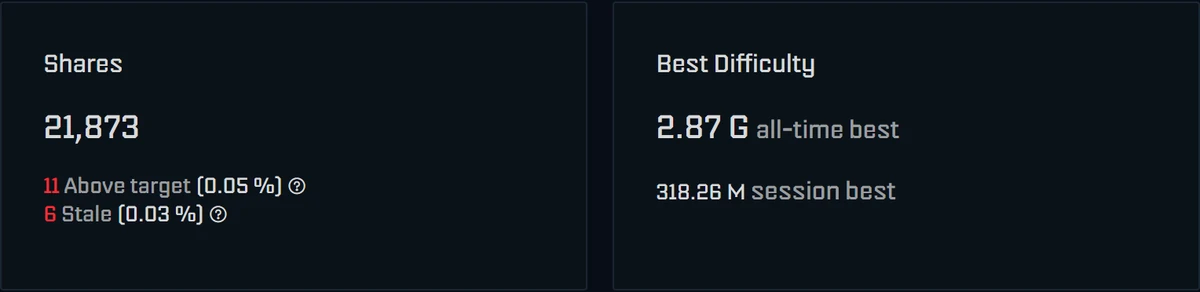
How large the best share gets can be calculated. It only grows in proportion to the running time: double the time or double the hashrate gives a typical value about twice as high. For a Gamma at 1.07 TH/s it looks like this (M = million, G = billion, T = trillion):
| Running time | Typical best share | 10 % chance of more than | 1 % chance of more than |
|---|---|---|---|
| 1 hour | 1.3 M | 8.5 M | 89 M |
| 1 day | 31 M | 204 M | 2.1 G |
| 1 week | 218 M | 1.4 G | 15 G |
| 1 month | 946 M | 6.2 G | 65 G |
| 1 year | 11.4 G | 75 G | 783 G |
| 10 years | 114 G | 747 G | 7.8 T |
The network difficulty of 132.76 T is about 12,000 times the typical yearly best of a Gamma. A best share of 50 G therefore does not bring you any “closer” to a block; every hash is a new, independent draw. The value is still useful as a health check: if a Gamma's best share after a week is well below 20 M, the miner is probably not hashing at full speed or keeps restarting. How to check that is explained in AxeOS explained.
Why your Bitaxe is never “due”
The most important property of this lottery: it has no memory. A device that has run for five years is not a bit closer to the next block than one fresh out of the box. There is no saving up and no run-up. That sounds frustrating, but it has a nice flip side: your first day has exactly the same chance as day 3,000. According to reports, the Bitaxe behind block 957,382 had been running for only about eight hours.
The word “luck” on pool pages also only describes the past. A pool with “200 % luck” was lucky, but it has no head start for the next blocks.
What happens if your Bitaxe finds a block?
If your miner finds a hash whose difficulty reaches that of the network, it sends it to the pool like any other share, and the pool immediately broadcasts the finished block to the network. AxeOS 2.15 tells you in three places:

- Dashboard: the green message “Today is your lucky day! Your device has found a block” with confetti.
- Browser tab: the title changes to “Block found 🎉”.
- Display: “!!! BLOCK FOUND !!!” scrolls after the best value.
The counter of found blocks is kept only in memory; after a restart the message is gone. The reward, of course, is not. You can verify the hit on your pool's statistics page and on mempool.space: the block's first transaction, the coinbase transaction, pays to your address.
How much arrives depends on the pool. On our solo pool pool.bitaxe.de the whole reward goes to your address without a fee, on solo.ckpool.org minus 2 %, on Braiins Solo minus 0.5 %. With your own node and Public Pool on Umbrel there is nobody in between. By a protocol rule, freshly mined bitcoin can only be spent after 100 further blocks, about 17 hours. Rarely a block can be orphaned if a competing block is found almost at the same time and the other chain wins.
The math without luck: the expected value
Soberly calculated, a Gamma earns 3.1445 BTC divided by 16,900 years on average, about 18,600 satoshis per year, currently around 13.80 euros. The electricity for it costs about 45 euros a year at 17 W and 0.30 euros per kWh. So a Bitaxe is no investment. If you just want to stack satoshis, buying them directly is cheaper.
A pool does not change this expected value, it only smooths it: instead of all or nothing you get the same expected amount in tiny payments, minus the fee. For a Gamma that is about 50 satoshis a day, practically only payable via Lightning. The difference between solo and pool is not a question of return but of variance. Which pools suit small miners is compared in choosing a mining pool; the power cost in detail is in Bitaxe power consumption.
Better than the lottery?
A EuroMillions jackpot ticket has odds of 1 in 140 million. A single block is even less likely for your Gamma at 1 in 860 million. But EuroMillions draws twice a week, the Bitcoin network about 144 times a day. Over a year, the Gamma's odds equal about 8,300 lottery tickets, which would cost around 20,000 euros. The Gamma needs electricity for about 45 euros for that.
The comparison is not entirely fair. The lottery also pays small prizes, solo mining only all or nothing. In return you end up with hardware on your desk that takes part in the real Bitcoin network and shows you how mining works. More on this idea in our solo mining guide.
How to really improve your odds
There is exactly one lever: more hashes, over more time.
- More hashrate per device: a NerdQaxe++ has well over four times the odds of a Gamma, a NerdOctaxe about ten times.
- Overclocking: 600 instead of 525 MHz means 14 % more tickets for about 2 W more. How to do it safely is in the overclocking guide.
- Several devices: odds add up. Five Gammas have five times the odds, and on a solo pool every hit still stays entirely yours.
- Uptime: a miner that keeps restarting because of heat or a weak power supply wastes tickets. Stable matters more than fast; the tips in making a Bitaxe quieter keep it quiet and cool.
- 0 % fee: it does not change the odds, but it changes what arrives if you hit. A 2 % fee would be about 4,600 euros less.
What does not help: switching pools “at the right time”, restarting after a high best share, mining only at night or hoping for a lucky phase after a found block. Every hash is independent of the one before.
Frequently asked questions
How likely is a Bitaxe Gamma to find a block?
How long does it take on average for a Bitaxe to find a block?
How much is a Bitcoin block worth?
How many blocks have Bitaxes found so far?
What does AxeOS show when my Bitaxe finds a block?
Is a high Best Difficulty a sign that I am close?
What Best Difficulty is normal for a Bitaxe Gamma?
Do my odds increase the longer the miner runs?
Do I have better odds in a pool?
Does overclocking increase the odds of a block?
What does the 2028 halving change about the odds?
Is a Bitaxe worth it when the odds are so small?
Matching products


Read more
Bitaxe Pool: solo mining from Frankfurt with 0 % fee, SOLO groups and Stratum V2
Our own solo mining pool for Bitaxe, Nerdaxe and NerdQaxe: 0 % fee, server in Frankfurt, a found block paid via coinbase straight to your address, SOLO groups with friends, plus Stratum V2 and Bitaxe Rewards since September 2026: points for every terahash hour, redeemable in the shop. What the pool does differently, who it suits and how to set it up in three minutes.
Bitcoin miningOverclocking a Bitaxe: AxeOS 2.15 guide with measured values and limits
How to unlock overclock mode in AxeOS 2.15, which steps to take, what others have measured with the Gamma, GT and NerdQaxe++, and where temperature, power supply and voltage regulator draw the line. Every limit checked in the firmware source code.
In our own wordsBitaxe affiliate program: 5 % commission on every referral, no network in between
Anyone who explains solo mining ends up recommending a miner. With the Bitaxe.de affiliate program you earn on it: 5 % of the net order value of every order via your link or your discount code, 30-day attribution, payout from €50 by SEPA or in Bitcoin. Built in-house, with no affiliate network and no tracking without consent. How the commission works and how to apply.