
Buying a Bitaxe miner: models, comparison, setup and accessories
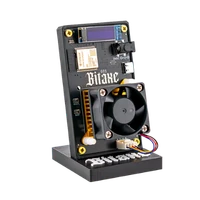
A Bitaxe miner is a compact open-source Bitcoin miner that makes Bitcoin mining considerably more accessible for individuals. Instead of relying on closed industrial hardware, Bitaxe stands for transparency, self-reliance and a practical way into home mining. That is exactly why the device has become so interesting for many Bitcoin enthusiasts, tinkerers and open-source fans.
Aktualisiert am 18. July 2026
Unlike classic large ASIC miners, Bitaxe is not only about maximum hash rate but about a different understanding of mining: smaller, more open, easier to grasp and closer to the actual Bitcoin infrastructure. If you want to do more than understand Bitcoin mining in theory — if you want to experience it at home — a Bitaxe is a particularly rewarding way in.
At the same time it is important to judge the Bitaxe miner realistically. It is not an industrial machine for large mining farms but a device for people who want to try mining themselves, learn from it and deliberately use an open system. For many, that is exactly where its greatest strength lies.
In this guide you will learn what a Bitaxe miner is, how it works, what sets it apart from classic ASIC miners and who a Bitaxe is really worth it for.
What is a Bitaxe miner?
A Bitaxe miner is a specialised Bitcoin miner developed for the SHA-256 algorithm and therefore used specifically to mine Bitcoin. Unlike the large classic machines from professional mining, though, Bitaxe is not primarily about raw performance but about an open and accessible approach.
What makes a Bitaxe miner special is the open-source idea. Hardware and software are not designed as an opaque black box; they are based on an open concept that the community can follow and develop further. That makes Bitaxe not just another mining device but, for many people, a practical way into the technical side of Bitcoin.
A Bitaxe miner is aimed above all at people who want to experience, understand and run Bitcoin mining at home themselves. While large ASIC miners are often loud, hot and designed for industrial environments, a Bitaxe is considerably more compact and far more tangible for home mining. That is exactly why Bitaxe has become such an interesting device in the open-source and home mining scene.
The right expectations matter here: a Bitaxe miner is not a replacement for large mining farms, nor is it built to compete with industrial ASIC systems on maximum hash rate. Its value lies in making Bitcoin mining more transparent, more understandable and accessible to individuals.
In short:
A Bitaxe miner is a compact open-source Bitcoin miner for everyone who wants not only to buy mining but to understand and experience it.
How does a Bitaxe miner work?
A Bitaxe miner works on the same basic principle as other Bitcoin miners: it continuously calculates SHA-256 hashes in order to find a valid block for the Bitcoin network. For that it uses a purpose-built ASIC chip. ASIC stands for application-specific integrated circuit, which in simple terms means a chip that was not built for many different tasks but specifically for Bitcoin mining.
As soon as the Bitaxe is connected to power and the network, it starts working. It receives mining tasks, processes new attempts continuously and checks whether a valid hit has appeared. That process runs automatically, around the clock, for as long as the device is active. This is the core of mining: a very large number of attempts in a very short time.
In practice that means the Bitaxe miner connects to a mining target — a mining pool, for example, or a solo mining setup. There it receives the information it needs to take part in the search for a valid Bitcoin block. With pool mining the work is bundled with many other miners; with solo mining the device works for a setup of your own.
The important terms here are hash rate, power draw and stability.
The hash rate describes how many attempts the miner can perform per second. Power draw plays an important role in efficiency and everyday practicality. And stability decides whether the miner runs reliably over time. In home mining in particular, raw performance is not the only thing that matters — a setup that stays practical day to day matters just as much.
A big advantage of the Bitaxe miner is that this principle becomes far more accessible than with many classic industrial miners. The device brings Bitcoin mining down to a format that individuals can follow and use at home. A very abstract technical process becomes something you can watch, configure and understand yourself.
Put simply, a Bitaxe miner works like this:
- The miner connects to a pool or a solo mining setup.
- It receives mining work.
- It calculates hashes continuously.
- It uses them to try to find a valid Bitcoin block.
- As long as there is no hit, it simply carries on working.
It is this simple basic sequence that makes Bitaxe so interesting for many people: the miner shows, in compact form, how Bitcoin mining actually works.
What makes Bitaxe special?
A Bitaxe miner is not simply another Bitcoin miner; it stands for an approach of its own. While many classic ASIC devices are developed mainly for maximum performance in professional mining farms, Bitaxe pursues a different idea: making Bitcoin mining open, understandable and usable at home.
A central difference is the open-source approach. With Bitaxe, hardware and software are not meant to be a closed black box but part of an open project. For many users that is one of the most important reasons why Bitaxe has drawn so much attention. If you want to understand how mining works, you get not only a finished device here but a far more transparent way into the technology behind it.
Then there is its strong suitability for the home. Large ASIC miners are often loud, hot and hard to fit into everyday life in a flat or a normal working environment. A Bitaxe miner is considerably more compact and therefore far more realistic for people who want to experience mining at home rather than in a farm. That is what makes it so interesting for home mining.
Another point is the learning and experience factor. Many people buy a Bitaxe not just to have a miner running but to finally understand Bitcoin mining in practice. The Bitaxe creates exactly that connection between technology, experimentation and real participation in the Bitcoin infrastructure. Instead of knowing mining only as an abstract concept, it becomes tangible with a device of your own.
On top of that comes the idealistic side. For many, Bitaxe also stands for more independence, more transparency and a stronger orientation towards the core ideas of Bitcoin. Anyone who values open source, decentralisation and self-determination often sees more than a product in Bitaxe — namely a different approach to mining as a whole.
This is what makes Bitaxe special:
- open source instead of a closed black box
- compact and suitable for the home instead of designed for farm operation
- ideal for learning and understanding
- closer to the idea of decentralised mining
It is this mix of openness, everyday practicality and genuine hands-on relevance that makes the Bitaxe miner the most interesting way into home mining for many people.
If you want to understand in more detail why open hardware and open firmware matter so much in mining, read our page on open-source Bitcoin mining as well.
Who is a Bitaxe miner worth it for?
A Bitaxe miner is worth it above all for people who see Bitcoin mining as more than an abstract concept and want to understand and experience it themselves. Unlike large industrial miners, Bitaxe is not aimed primarily at professional farm operators but at users looking for a more accessible, more transparent and more practical way in.
A Bitaxe miner is particularly interesting for Bitcoin enthusiasts who want to engage more deeply with the technical side of the network. If you want to do more than hold Bitcoin — if you want to understand it better — a Bitaxe gives you direct insight into how mining works.
It is also a very rewarding choice for tinkerers, makers and open-source fans. Precisely because the project is built on openness and transparency, the device suits everyone who enjoys following the technology themselves, optimising setups and digging deeper into the subject.
Another good match are people who want to try home mining. Large ASIC miners are simply too loud, too hot or too impractical for many households. A Bitaxe miner is far more tangible for anyone who wants to experience mining at home on a smaller scale.
Then there are users who particularly value the idealistic side. Anyone to whom decentralisation, open source and self-reliance matter often sees in the Bitaxe not just a device but a way of being actively closer to the Bitcoin infrastructure.
That honest assessment matters: a Bitaxe miner is especially strong for people who want to learn, experiment and actively experience home mining — not for users simply looking for the highest possible performance per device.
A Bitaxe miner is particularly worth it for you if you …
- want to understand Bitcoin mining yourself
- are looking for a compact setup for your home
- consider open source and transparency important
- enjoy technology, experiments and a setup of your own
- do not judge mining purely by maximum hash rate
A Bitaxe miner is rather less ideal for you if you …
- are mainly after industrial performance
- are looking for maximum hash rate and pure scale
- judge mining exclusively by short-term profitability
- want to replace a large professional farm setup
Bitaxe miner vs. classic ASIC miners
A Bitaxe miner is often compared with classic ASIC miners. That makes sense in principle, because both are used for Bitcoin mining. In practice, though, they usually pursue different goals.
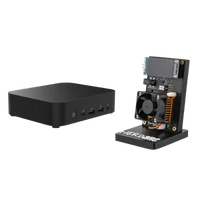
Classic ASIC miners are generally designed for maximum performance. They are often used in professional mining farms, deliver very high hash rates and are built for an environment in which noise, waste heat and space matter far less than efficiency at scale. For private users such devices are often hard to fit sensibly into everyday life.
A Bitaxe miner, by contrast, takes a different approach. It is not about competing with industrial systems for the highest total performance but about making Bitcoin mining more open, more accessible and more suitable for the home. A Bitaxe is considerably more compact and therefore more interesting for people who want to mine, learn and run a setup of their own at home.
So the most important difference lies not only in performance but in the philosophy of use. A classic ASIC miner is typically a tool for scaled mining operations. A Bitaxe miner is more a device for home mining, open source, learning and engaging directly with the technology.
Of course that also means judging a Bitaxe realistically. If you look exclusively at maximum hash rate, professional throughput and industrial scale, large ASIC systems are a different category of hardware altogether. If, on the other hand, you are looking for a device that makes mining tangible in practice and fits small setups far better, the Bitaxe is a very interesting alternative.
Classic ASIC miners:
- designed for very high hash rates
- often loud, hot and large
- more strongly geared towards farm operation and scale
- usually considerably less accessible for beginners
Bitaxe miners:
- more compact and better suited to the home
- open-source oriented
- ideal for learning, understanding and experimenting
- not intended as a direct replacement for industrial miners
Bitaxe miner: pool mining or solo mining?
A Bitaxe miner can be used for both pool mining and solo mining. Both pursue the same basic goal — taking part in the search for a valid Bitcoin block — but in practice they differ considerably.
In pool mining, your Bitaxe miner works together with many other miners in a pool. The combined computing power finds blocks more often, and the reward is then distributed proportionally among the participants. The big advantage is that earnings are much more regular and predictable, even though they are smaller.
With solo mining it works the other way round. Here your Bitaxe miner does not work as part of a large pool but for your own setup. If a valid Bitcoin block really is found, the entire reward goes to you, or to your setup. At the same time, the probability of such a hit with a single device is very small.
For many users that difference is decisive. Pool mining is usually the more practical choice if you look at mining in terms of regularity, easy assessment and stable participation. Solo mining, by contrast, appeals above all to people who value the idealistic, technical and independent side of mining.
With a Bitaxe miner, solo mining feels particularly appealing, because the device makes exactly this kind of home mining more accessible. Instead of only feeding hash rate into a large pool, you run your own small setup and experience mining far more directly. Even so, stay realistic: solo mining is not a predictable source of income but a combination of technology, learning and a very small chance of a block find of your own.
If you want to understand the basics first, read our page on solo mining.
Which Bitaxe models are there?
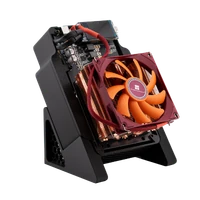
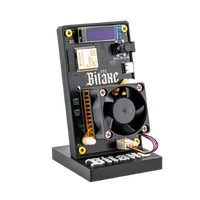
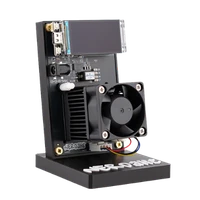
There are now several models and variants under the name Bitaxe miner, differing by generation, features and performance. For newcomers the important thing to understand is this: not every Bitaxe is automatically identical, even though all the devices share the same basic idea — open-source Bitcoin mining in a compact format.
- Bitaxe: the original – one ASIC, compact, the usual way in. Models: Gamma, Copperzilla, GT, 702.
- Nerdaxe: the same technology, a large display and a board design of its own.
- NerdQaxe and NerdOctaxe: four and eight ASICs respectively for considerably more hash rate – louder, warmer, more expensive.
Depending on the model, Bitaxe miners differ in the hardware used, the hash rate they reach, their energy requirements and the use cases they are aimed at. Some variants suit users who simply want an uncomplicated way into home mining. Others are more interesting for people who want to compare specifically, optimise or build a particular setup.
For most users, though, what matters is not knowing every technical detail of every model by heart but asking the right basic question: which Bitaxe miner fits my goal?
Do you want the simplest possible start? Do you want to try solo mining? Are you looking for a compact device for learning and home mining? Or do you want a model aimed more at experienced users?
That is why, when it comes to the models, it pays to look less at raw numbers alone and more at the intended use. A Bitaxe miner is never only a technical product; it is always part of a particular setup and a particular expectation.
When choosing the right Bitaxe model, pay attention to these points above all:
- hash rate – how much computing power the model offers
- power draw – how efficient and practical the device is in operation
- cooling and stability – particularly important in continuous use
- intended use – getting started, home mining, solo mining or more experimental use
- setup and handling – how easily the model can be put into operation
If you are just starting out, the „strongest“ model is usually not automatically the best choice — the one that fits your own goal is. For many users a Bitaxe is particularly interesting when the device is easy to understand, practical at home and openly built.
How do you set up a Bitaxe?
Setting up a Bitaxe miner is considerably more accessible than many users first assume. Compared with large classic ASIC miners in particular, getting started is usually simpler, more compact and better suited to use at home. Even so, it is worth understanding the basic sequence so the first start does not turn into a puzzle.
It begins with the basic installation. The Bitaxe miner is supplied with power, connected to the network and then configured through its interface. The goal is to set the device up so that it works correctly with a mining target and runs stably over time.
Then comes the actual configuration. That typically includes the network connection, choosing a mining pool or a solo mining setup, and entering the data needed for operation. Once those steps are complete, the Bitaxe miner can start working and producing hash rate.
It is important not to see the setup as unnecessarily complicated. For most users the core is a manageable sequence: connect, link up, configure, check. That is exactly what makes Bitaxe so attractive for beginners and home miners.
Simplified, the setup works like this:
- Connect the Bitaxe miner
Supply the device with power and make it ready for operation. - Connect it to the network
Get the miner onto the right network. - Configure the mining target
Set up pool mining or solo mining. - Check the settings
Verify that all the details are correct. - Watch hash rate and stability
Make sure the miner is working reliably.
If you want to put the setup into practice now, our Bitaxe setup guide covers every step in detail. You will find further help, FAQs and ways to get in touch in the support area.
Anyone looking at a Bitaxe miner for the first time tends to have similar questions. That is entirely normal, because Bitaxe sits exactly at the intersection of Bitcoin, open source, home mining and hands-on technology. That is precisely why it helps to sort out the most common points clearly and simply.
Conclusion: why Bitaxe is the most interesting way into home mining for many people
A Bitaxe miner is not classic mining hardware built to industrial scale — and that is exactly what makes it so interesting to many people. Instead of aiming at maximum scale and farm operation, Bitaxe brings Bitcoin mining into a format that individuals can understand, access and actually use at home.
The particular strength of a Bitaxe miner lies in the combination of open source, home suitability and direct technical experience. If you want to do more than look at Bitcoin mining from the outside — if you want to experience it and understand it better — this is a way in that is far more tangible than with many large ASIC systems.
At the same time an honest assessment matters: a Bitaxe miner is not meant to replace professional mining farms or to win on maximum performance alone. Its real value is that it brings people closer to the infrastructure of Bitcoin — practically, openly and comprehensibly.
For Bitcoin enthusiasts, tinkerers, open-source fans and everyone who wants to try home mining seriously, Bitaxe is therefore far more than a small mining device. It is direct access to one of the most fascinating areas of the Bitcoin network.
If you want to understand Bitcoin mining yourself and make it tangible at home, a Bitaxe miner is one of the most interesting ways to begin.
See suitable Bitcoin miners
If you want to pick suitable hardware or accessories straight after this guide, these pages are the most important next steps:
Ready to try solo mining yourself? If you want to start your own home mining setup, you will find suitable Bitaxe miners here for getting into open-source Bitcoin mining.