
Buying guide for Europe
Buy a Bitaxe: open-source Bitcoin miners for solo mining at home
Four Bitaxe models, plus Nerdaxe and NerdQaxe: the differences are in hashrate, power draw, cooling and noise, not in the returns. This page sorts out which device fits your home, what running it really costs per month and what a solo miner can actually do.
Which Bitaxe suits you?
Most people decide on hashrate first and are annoyed by fan noise or waste heat later. The sensible order is the other way round: first work out where the device will stand, then power draw and noise, then compute. A miner that is a nuisance in your study ends up not running at all.
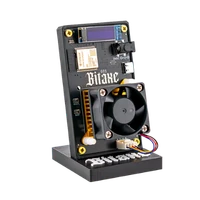
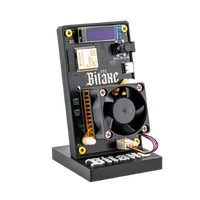
- First miner, has to be quiet in a living space: Bitaxe Gamma 601. One BM1370 ASIC, around 17 W, a 5 V power supply and a fan that follows the temperature.
- More hashrate, same handling: Bitaxe GT with two BM1370, 2.15 TH/s at around 43 W and a 12 V supply.
- Maximum performance in a single Bitaxe: Bitaxe 702 (Supra Hex) with six BM1368, about 3.75 TH/s stock at 75 to 90 W. That one needs air around it.
- Copper heatsink and continuous operation: Bitaxe Copperzilla. Technically a Gamma 601 with a solid copper cooler, shipped with OSM-OS at 750 MHz and therefore around 1.5 TH/s.
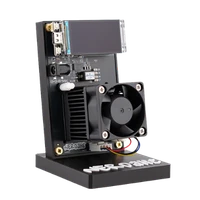
- Large display, own board design: Nerdaxe Gamma, or with the newer BM1373 the Nerdaxe Gaia: 2.4 to 2.8 TH/s at 26 to 31 W, around 11 to 12.5 J/TH and so the most efficient device in the range. The Gaia is currently available for pre-order; the product page shows the delivery date.
- Considerably more compute: NerdQaxe++ (around 4.8 TH/s) or NerdOctaxe (up to around 12 TH/s). That is another league in power draw, heat and noise.
The models compared
The figures are guide values: hashrate from the firmware and from real operation, power from measurements and manufacturer data. Where sources differ, you see a range. On the Gamma, AxeOS expects 1.07 TH/s at factory settings; in daily use the dashboard usually shows 1.1 to 1.2 TH/s. The price column is pulled live from the shop, so it is always today’s price.
| Model | Hashrate | Power draw | Efficiency | ASIC | Price |
|---|---|---|---|---|---|
| Bitaxe Gamma 601 | ~1.1 to 1.2 TH/s | ~17 W | ~14 to 16 J/TH | 1× BM1370 | €139.00 |
| Bitaxe Copperzilla | ~1.5 TH/s | ~23 to 30 W | ~14 to 18 J/TH | 1× BM1370 | €179.00 |
| Bitaxe GT | 2.15 TH/s | ~43 W | ~20 J/TH | 2× BM1370 | €229.00 |
| Bitaxe 702 | ~3.75 TH/s | ~75 to 90 W | ~20 to 21 J/TH | 6× BM1368 | €239.00 |
| Nerdaxe Gamma | ~1.05 to 1.3 TH/s | ~17 to 21 W | ~15 to 16 J/TH | 1× BM1370 | €159.00 |
| Nerdaxe Gaia | ~2.4 to 2.8 TH/s | ~26 to 31 W | ~11 to 12.5 J/TH | 1× BM1373 | €249.00 |
| NerdQaxe++ | ~4.8 TH/s | ~76 W | ~16 J/TH | 4× BM1370 | €349.00 |
| NerdOctaxe | up to ~12 TH/s | ~160 to 200 W | ~16 J/TH | 8× BM1370 | €699.00 |
Efficiency in joules per terahash tells you how much electricity a device needs for the same work; lower is better. Between around 11 J/TH (Gaia) and around 20 J/TH (GT, 702) lies almost a factor of two in electricity cost per terahash. By the way, the power reading in AxeOS is an estimate at the voltage regulator, not a measurement at the wall. If you want to know exactly, use a plug-in power meter.
Bitaxe models in the shop
Availability, reviews and prices are on the cards themselves. If a model is sold out, you can often place a backorder; the expected waiting time is then shown on the product page.

Bitaxe Gamma | 1.3 TH/s

Bitaxe GT | 2.15 TH/s

Bitaxe 702 | 4.2 TH/s

Bitaxe Copperzilla | 1.5 TH/s

Nerdaxe Gamma | 1.3 TH/s

Nerdaxe Gaia | 2,6 TH/s
Which Bitaxe versions exist?
The number after the name tells you the series. The hundreds digit stands for the board and therefore the chip, the remaining digits mark board revisions. A 602 or 603 is therefore not a faster Gamma: chip, factory clock and expected hashrate are identical for all three in the firmware. These are the boards AxeOS 2.15.3 knows:
| Number | Series | Chip | Power supply | Factory hashrate |
|---|---|---|---|---|
| 601, 602, 603 | Bitaxe Gamma | 1× BM1370 | 5 V | 1.07 TH/s |
| 601 with copper cooler | Bitaxe Copperzilla | 1× BM1370 | 5 V | 1.53 TH/s (OSM-OS, 750 MHz) |
| 650 | Bitaxe Gamma Duo | 2× BM1370 | 5 V | 1.63 TH/s |
| 701, 702 | Bitaxe Supra Hex | 6× BM1368 | 12 V | 3.75 TH/s |
| 801 | Bitaxe Gamma Turbo (GT) | 2× BM1370 | 12 V | 2.14 TH/s |
| 1201 | Naja Duo (Bitaxe Color) | 2× BM1372/BM1373 | 12 V | 4.40 TH/s |
| 1300 | Gamma Hex (Bitaxe Color) | 6× BM1370 | 12 V | 8.45 TH/s |
The firmware calculates the factory hashrate from clock, cores and chips; in operation it drifts a little up or down depending on the device. AxeOS also supports older series such as the Max (BM1397), Ultra (BM1366) and Supra (BM1368). Naja Duo and Gamma Hex were added in AxeOS 2.15.2 and are not part of our range. AxeOS shows the board number of your device on the System page under “Board Version”.
What a Bitaxe actually does
A Bitaxe is a full Bitcoin miner in miniature: it receives block templates from the pool, computes SHA-256 and sends valid results back. When solo mining it works for our solo pool pool.bitaxe.de (host stratum.bitaxe.de, port 3333, 0 % fee, servers in Frankfurt) or for your own node. Technically it does the same as a machine in a data centre, just with a tiny share of the world’s computing power.
In solo mining every hash is its own lottery ticket. If your device finds a block, the entire reward of currently 3.125 BTC plus transaction fees goes to you, not a share of it but all of it. A Gamma at factory settings has a chance of about 1 in 16,900 per year (difficulty as of 26 September 2026), and that chance does not grow because the device has been running for a long time. That it still happens is shown by five documented solo blocks from Bitaxe devices since 2024. The maths and the blocks are in Finding a block with a Bitaxe, and the mining calculator works out your personal odds.
If you prefer to see small predictable amounts, run the miner in a shared pool. On average the result is the same, just without the chance of the whole block. Both work with the same hardware, and switching takes less than a minute on the Pool page in AxeOS. Which pools suit a Bitaxe is compared in Choosing a Bitaxe mining pool; the basics are in our solo mining guide.
What a Bitaxe is not: an investment. In expected value a Gamma earns around €14 a year, while its electricity costs around €45. The value lies in helping to secure the network yourself, understanding the technology and working without a middleman.
Electricity cost per month
Calculated with continuous operation (730 hours a month) and €0.30 per kWh. Use the mining calculator for your own tariff; measurements and tips for saving power are in Bitaxe power consumption.
| Model | Power draw | Consumption per month | Cost per month |
|---|---|---|---|
| Bitaxe Gamma 601 | ~17 W | ~12.4 kWh | about €3.70 |
| Nerdaxe Gamma | ~17 to 21 W | ~12 to 15 kWh | about €3.70 to €4.40 |
| Bitaxe Copperzilla | ~23 to 30 W | ~16 to 20 kWh | about €4.80 to €5.90 |
| Nerdaxe Gaia | ~26 to 31 W | ~19 to 23 kWh | about €5.70 to €6.80 |
| Bitaxe GT | ~43 W | ~31 kWh | about €9.40 |
| NerdQaxe++ | ~76 W | ~55 to 58 kWh | about €16.60 to €17.50 |
| Bitaxe 702 | ~75 to 90 W | ~55 to 66 kWh | about €16.40 to €19.70 |
| NerdOctaxe | ~160 to 200 W | ~117 to 146 kWh | about €35 to €44 |
Noise, heat and the right spot
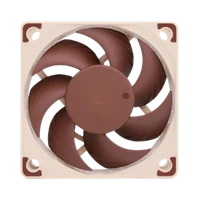
The single-chip devices (Gamma, Copperzilla, Nerdaxe) control their fan by temperature. In a quiet room you can hear them, but they are unobtrusive and can sit on your desk. If you want it quieter, fit a Noctua fan or a bigger cooler. From the GT upwards more heat has to leave the board and the fan becomes audible; from the 702 and the NerdQaxe models the device belongs on a shelf, in a hallway or in a homelab. What actually helps is in Making a Bitaxe quieter.
Heat is not a side effect but the main output: a device drawing 90 W puts 90 W of heating into the room. Pleasant in winter, an argument for a cooler spot in summer. The chip must not get too hot though: AxeOS warns from 70 °C and stops mining above 75 °C chip temperature or 105 °C at the voltage regulator, while NerdOS shuts down at 70 °C by default. Matching heatsinks and fans as well as upgrades are in the shop.
What you need besides the miner
- Power supply: Gamma, Copperzilla and Nerdaxe Gamma run on 5 V / 6 A (30 W), the GT on 12 V / 5 A, the Nerdaxe Gaia on 12 V / 6 A, the 702 and the NerdQaxe models on 12 V / 10 A, and the NerdQX and NerdOctaxe on 12 V / 20 A. The matching supply is included with every miner, and replacements are in accessories. Why a supply that is too weak causes restarts is explained in Power supply for a Bitaxe.
- Wi-Fi on 2.4 GHz: the ESP32-S3 on board does not connect to 5 GHz-only networks. On modern routers it usually helps to separate the bands briefly. Connected but not mining: troubleshooter.
- A target for the work: a pool address plus your Bitcoin address. Our solo pool needs no account, and the pool configurator gives you the values, including encrypted Stratum V2 on port 3336. Alternatively you mine against your own Bitcoin node.
- Current firmware: flasher.bitaxe.de updates the miner in the browser. OSM-OS, our recommendation, is preselected; with the “Keep configuration” box ticked, Wi-Fi and pool settings stay in place.
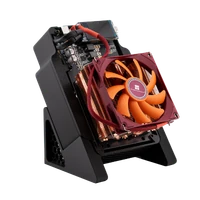
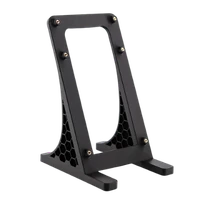
- Optional: a mount or case so the device stands cleanly, plus a quieter fan for continuous operation.
Bitaxe, Nerdaxe or NerdQaxe?
All three come from the same open-source family and share pool values, setup route and flasher. The Bitaxe is Skot’s original and the leanest build; it runs AxeOS. The Nerdaxe models from BitMaker’s circle use their own board with a large display. NerdQaxe and NerdOctaxe stack four or eight ASICs on one board and deliver a multiple of the hashrate, but need a power supply, cooling and space of a different class. The Nerd devices do not run AxeOS but NerdOS, a branch of the same firmware family with its own interface. The Nerdaxe Gaia also uses a different chip, the BM1373.
The direct comparison with tables is in Bitaxe or Nerdaxe, the overview of all series in the guide Buy a Bitcoin miner. The technical background is in the Bitaxe miner guide, and the larger devices are covered in the NerdQaxe++ review and Nerdaxe Gaia explained.
What to check before you buy
The Bitaxe board and firmware are open, which is why many manufacturers build and sell devices to this design. That is intended, but it also means that components, coolers, power supplies and service differ. These four points are worth checking before you buy:
- Board and firmware: which board number does the device have, and does it run current firmware? AxeOS shows both on the System page; the current version is AxeOS 2.15.3 (as of 26 September 2026).
- Power supply: is a supply of the right class included? A weak one only shows under load, as a restart or as the “Danger: Low Voltage” warning on the dashboard.
- Warranty and returns: who is liable if the device arrives faulty? With a retailer in the EU, statutory warranty and the right of withdrawal apply.
- Shipping and customs: if the goods ship from within the EU, there are no customs duties or import charges inside the EU. For parcels from outside the EU, import VAT and duties may be added.
Buying a Bitaxe at bitaxe.de
- Shipping from Europe: we ship from our European fulfilment centre with DHL and UPS. Items in stock leave within 24 hours on working days, and inside the EU the parcel usually arrives within two to four working days, without customs. Shipping costs are listed under Shipping and delivery and in the cart.
- Payment: Bitcoin and Lightning (5 % off the goods value), card, Apple Pay, Google Pay, PayPal (+3 %) or bank transfer. How paying with Bitcoin works is explained in Paying with Bitcoin.
- Warranty and returns: statutory warranty, a 14-day right of withdrawal and support from people who run these devices themselves.
- Guides included: step-by-step instructions for Bitaxe, Nerdaxe and NerdQaxe, plus tools such as the pool configurator and the troubleshooter.
- Bitaxe Rewards: mining on the Bitaxe Pool earns points that you redeem in the shop as a discount. How the rewards work.
In short
If you want to buy a Bitaxe and are still undecided: take the Gamma 601. It is quiet enough for any room, costs about €3.70 of electricity a month and technically does everything the larger models do. If you want more hashrate with the same handling, the GT is the next step and the 702 the top of the single-device range. And if you are planning a jump into another performance class, you end up at the NerdQaxe++ or NerdOctaxe.
Frequently asked questions
What does a Bitaxe cost?
How much electricity does a Bitaxe use per month?
How loud is a Bitaxe?
Bitaxe Gamma or Bitaxe GT: which is better?
What do 601, 602 and 603 mean on a Bitaxe Gamma?
Is a Bitaxe financially worthwhile?
Can you really find a block with a Bitaxe?
Which power supply does a Bitaxe need?
How do I set up a Bitaxe?
Bitaxe_XXXX and enter your 2.4 GHz network on the setup page. Then open AxeOS via the IP address on the display (since AxeOS 2.15 also via the hostname, for example http://bitaxe.local) and enter host, port and your Bitcoin address on the Pool page. You do not need your own node for this; the pool configurator provides the values and the setup guide shows the whole process with pictures.