



Who owns the Bitaxe?
24 August 2026 · 24 min read · Updated on 30 September 2026

The short version
- For four open-source project names that are not theirs, the company behind solomining.de has registered or applied for nine German and European trademarks, two of them for devices it does not even sell.
- In April 2026 Bitronics Lab S.L., the company behind the NerdMiner developer’s shop, filed an opposition against the “Nerdminer” EU application. The proceedings are ongoing.
- It began before the first trademark existed: in February 2024 with a warning against us to the entire community, in March 2024 with a complaint claiming the open project as “our copyright”.
- It used those marks to have 71 pages deleted from Google. After our cease-and-desist letter, Google restored every one of them, and a lawsuit now sits ready for signature.
- Its lawyers state the registration and enforcement were coordinated with the project’s author, in public, the opposite was said. Both cannot be true.
- Payments from solomining to project developers are confirmed by the project founder. Who received them, how much, on what evidence: unanswered. The discussion was locked 41 seconds after the answer.
- Against Chinese filings of the very same names, in the EU and even in Germany, nothing was ever done. Only against us.
None of this has to be taken on trust. Every statement in this text comes from an official register, a public database or a document we show and link to here.
What happened
On 19 April 2026 Google notified us that a counterfeit complaint had been filed against bitaxe.de. A second notification about the same matter followed on 25 April. In the end 71 URLs of our shop were affected. A few days before the first notice, the same party had already filed a copyright complaint with our hosting provider. Google acted on the complaint. The pages dropped out of the index.
The complainant was Bolt Engineering GmbH of Fellbach, Germany, the company that operates the shop solomining.de. Its legal notice identifies it as “Bolt Engineering GmbH, represented by its managing director Jannis Langer, Höhenstr. 10, 70736 Fellbach”, registered at Mannheim district court under HRB 743598. They never contacted us. We learned of both actions only through the platforms they were aimed at.
What came afterwards no longer resembles an ordinary dispute between two shops: a letter from their lawyers, the discussions in the Bitaxe project’s repository, and above all a look into the trademark registers. Over two years, a portfolio of rights over other people’s project names was built up there in silence, and those rights were used against exactly one competitor: us. Every attempt to clear the matter up in public has so far ended the same way. Reviews were closed, discussions locked, questions left unanswered. The vendor remains on the Bitaxe project’s recommended list to this day.
The chronology at a glance
| When | What |
|---|---|
| Feb 2024 | WantClue warns the entire OSMU Discord: “Bitaxe.de looks fishy and smells like scam”, no evidence, no questions asked. |
| March 2024 | Complaint against bitaxe.de filed with Cloudflare via info@wantclue.de: bitaxe.de is called a “direct copycat of our Bitaxe project”. |
| Sep/Oct 2024 | Bolt Engineering files “Bitaxe” and “Nerdaxe” as German word marks. |
| Oct 2025 | “Nerdminer” and “NerdQaxe++” follow, devices solomining does not sell. |
| Feb–Mar 2026 | EU figurative mark “Bitaxe”, then on 20 March at least four EU filings on a single day: Nerdaxe, NerdQaxe++, Nerdminer and Heatpunk. |
| April 2026 | Counterfeit complaint to Google: 71 bitaxe.de pages drop out of the index. |
| 20 April 2026 | Bitronics Lab S.L. files an opposition at the EUIPO against the “Nerdminer” EU application. The proceedings are ongoing. |
| 14–18 May 2026 | Review of the solomining listing; closed within four days on WantClue’s exoneration. |
| 22 May 2026 | Lawyers’ letter: registration “coordinated with the holder of the title rights”, licences to two competitors. |
| 18/19 Aug 2026 | Motion to remove bitaxe.de from the legitlist. |
| 24 Aug 2026 | Skot confirms the payments from solomining, and the discussion is locked 41 seconds later. |
| Since then | Our cease-and-desist letter; Google restores all 71 pages; the lawsuit sits ready for signature. |
Nine trademarks over four projects that are not theirs
The names at stake here come from an open developer community. Bitaxe was created by Skot / bitaxeorg and released under an open licence. Nerdaxe and Nerdminer come out of BitMaker’s work, NerdQaxe++ from shufps. All four are community projects, not commercial brands.
A search of the official registers, the German Patent and Trade Mark Office and the European Union Intellectual Property Office, retrieved through TMview, returns the following marks held by Bolt Engineering GmbH for these four project names, all in class 9 (as of 30 September 2026):
| Mark | Office | File number | Filed | Registered |
|---|---|---|---|---|
| Bitaxe (word) | DPMA | 30 2024 236637 | 28 Sep 2024 | 31 Jan 2025 |
| Nerdaxe (word) | DPMA | 30 2024 237502 | 5 Oct 2024 | 30 Jan 2025 |
| Bitaxe (word) | EUIPO | 019206471 | 23 Jun 2025 | 10 Oct 2025 |
| Nerdminer (word) | DPMA | 30 2025 246451 | 5 Oct 2025 | 17 Apr 2026 |
| NerdQaxe++ (word) | DPMA | 30 2025 246708 | 7 Oct 2025 | 9 Feb 2026 |
| Bitaxe (figurative) | EUIPO | 019315675 | 11 Feb 2026 | 28 May 2026 |
| Nerdaxe (word) | EUIPO | 019333780 | 20 Mar 2026 | 2 Jul 2026 |
| NerdQaxe++ (word) | EUIPO | 019333815 | 20 Mar 2026 | 3 Jul 2026 |
| Nerdminer (word) | EUIPO | 019333841 | 20 Mar 2026 | no, opposition pending |
Three things stand out.
First, the date of the earliest filing. The German word mark “Bitaxe” was filed on 28 September 2024. bitaxe.de had been selling under that name for well over a year by then; snapshots of our shop are preserved in the Internet Archive. A first complaint against us had already been filed half a year earlier, by an OSMU developer claiming the open project in it as “our project” and its code as “our copyright” (more on that below). The name was neither free nor unused when it was claimed.
Second, the pattern. Bitaxe and Nerdaxe were filed one week apart. Nerdminer and NerdQaxe++ followed exactly a year later, two days apart. On 20 March 2026 at least four EU applications went out on a single day, three of them for project names, the fourth for “Heatpunk”. These are not isolated decisions. This is a programme.
Third, the reach. Four projects, four different authors, one applicant. None of the authors is Bolt Engineering GmbH.
Further trademarks held by Bolt Engineering GmbH
The nine marks above cover only the four project names. The company’s portfolio is larger. The EUIPO register lists at least three further word marks held by Bolt Engineering GmbH:
| Mark | EUIPO file number | Classes | Filed | Registered |
|---|---|---|---|---|
| Copperzilla | 019235425 | 9, 11 | 21 Aug 2025 | 4 Dec 2025 |
| Hashpunk | 019236519 | 9, 25, 35 | 24 Aug 2025 | 6 Dec 2025 |
| Heatpunk | 019333894 | 9, 11 | 20 Mar 2026 | 2 Jul 2026 |
Heatpunk stands out because of its date: it was filed on the same day as the Nerdaxe, NerdQaxe++ and Nerdminer EU applications. It covers not only computer hardware, chips and cryptocurrency software (class 9) but also heating apparatus, heat exchangers and electric heaters (class 11). Copperzilla is the name of a copper cooler that solomining.de sells as its own product; the mark covers heat sinks, computer hardware and cooling apparatus. Hashpunk is registered for computer hardware, clothing, and retail and wholesale of computer hardware.
These three marks have nothing to do with the dispute this article is about. Unlike Bitaxe, Nerdaxe, Nerdminer and NerdQaxe++, the names do not, as far as we know, come from the open-source community, and protecting your own product names is ordinary business. We list them for a different reason: the figure of nine describes only the marks over the four project names, not the company’s entire portfolio. Whether further marks exist, at the DPMA or outside the EU for example, we have not fully checked. The list is therefore a lower bound.
The Nerdminer test
A trademark is meant to protect a business you actually run. It stops someone else from trading under the name you trade under. So the most revealing question you can ask about any filing is simply: does the applicant sell the product at all?
We went through the full catalogue of solomining.de, 26 items as of 24 August 2026, titles and descriptions. The result:
| Name | Trademark held | Device in the shop | Appears in the catalogue as |
|---|---|---|---|
| Bitaxe | DE + EU, word and figurative | yes | devices, accessories, apparel |
| NerdQaxe++ | DE + EU | yes | device and power supply |
| Nerdaxe | DE + EU | no | a replacement power supply and a stand |
| Nerdminer | DE + EU | no | nothing at all |
The German word mark Nerdminer was filed on 5 October 2025 and registered on 17 April 2026; the EU application followed on 20 March 2026 and has since been opposed (more on that below). The word “Nerdminer” does not appear anywhere in that shop, not as a product, not as an accessory, not in a single description. For Nerdaxe there is no device either, only accessories for hardware that other people sell.
Opposition to the Nerdminer EU trademark
Since 20 April 2026, Bolt Engineering GmbH’s EU application for “Nerdminer” has been contested. On that day Bitronics Lab S.L. of Vilassar de Mar near Barcelona filed an opposition at the EUIPO. The register has listed the application as “Application opposed” ever since.
| According to the EUIPO register | |
|---|---|
| Application | Nerdminer (word), 019333841, filed 20 Mar 2026, class 9 |
| Published | 15 Apr 2026, opposition period until 15 Jul 2026 |
| Opposition | No. 003260916, filed 20 Apr 2026 |
| Opponent | Bitronics Lab S.L., Vilassar de Mar, Spain |
| Grounds | Art. 8(4) EUTMR: an earlier non-registered sign |
| Scope | all goods of the application |
| Status | open, no decision (retrieved 30 Sep 2026) |
What stands out is who is opposing. Bitronics Lab S.L. operates the shop bitronics.store, which calls itself the “NerdMiner creator’s store” and is linked from the GitHub profile of BitMaker, the developer of the NerdMiner. So the challenge does not come from an outsider but from the company around the people the name comes from.
The legal basis fits. Article 8(4) of the EU Trade Mark Regulation protects earlier signs that are not registered as trademarks but are used in the course of trade with more than mere local significance. An opponent relying on it does not point to a register entry of its own, but to the name having been used in the market before the application was filed.
The German “Nerdminer” mark (DPMA 30 2025 246451) is not affected. No opposition was filed against it before the opposition period ended on 24 August 2026, and it remains registered. An application for cancellation at the DPMA, for instance on grounds of bad faith, remains possible independently of that.
The justification the register does not support
There is a stock defence for trademarking open-source project names: someone has to protect the name from cheap Chinese copies. It sounds reasonable. It is also testable, because if it were true, the register would show action taken against Chinese filings.
It shows the opposite. The same names have long since been filed by Chinese companies, in Europe, in Germany, in the UK, New Zealand, Canada and the US. A selection:
| Mark | Office | Owner | Filed | Registered |
|---|---|---|---|---|
| BITAXE | China (77186736) | company based in Shenzhen | 8 Mar 2024 | 7 Sep 2024 |
| BITAXE MINER | EUIPO (019161763) | Shenzhen Ruiyuhe Technology | 25 Mar 2025 | 6 Jul 2025 |
| NerdQaxe++ | DPMA (3020261015960) | Shenzhen Yaoxing Trading | 26 Jan 2026 | 11 Mar 2026 |
| NerdMiner | DPMA (3020261015987) | Zhanjiang Zhuocai Trading | 26 Jan 2026 | 16 Mar 2026 |
| BITAXE NERDQAXE | EUIPO (019313656) | Shenzhen Bite Tengfei Technology | 6 Feb 2026 | pending |
The first row is already telling: “BITAXE” was registered in China on 7 September 2024, three weeks before Bolt Engineering GmbH filed its first German application. Anyone hoping to protect the name from China was already too late at that point.
The second row is the one that matters. The EU mark “BITAXE MINER”, owned by a company in Shenzhen, was open to opposition until 28 June 2025. Bolt Engineering GmbH had held the German word mark “Bitaxe” since January 2025, valid grounds for an opposition. They were demonstrably occupied with trademark matters in exactly that window: on 23 June 2025, five days before the deadline expired, they filed their own EU mark. No opposition against the Chinese application is on record. It was registered on 6 July 2025.
It goes further. Two Chinese companies now hold German word marks for “NerdMiner” and “NerdQaxe++”. Zhanjiang Zhuocai’s Nerdminer mark was registered on 16 March 2026, a month earlier than the identical mark held by Bolt Engineering GmbH. Again: no visible opposition, no complaint, no public reaction.
And the argument fails twice over. An EU trademark bites on import and distribution inside the single market. It does not trouble a direct seller in Shenzhen shipping single parcels to European consumers. It works precisely where a competitor has a legal notice, a VAT number and an address you can serve papers at, which is to say, against the sellers who play by the rules.
The complaint to Google
This is the message that started it all for us, the Google Search Console notification of 19 April:
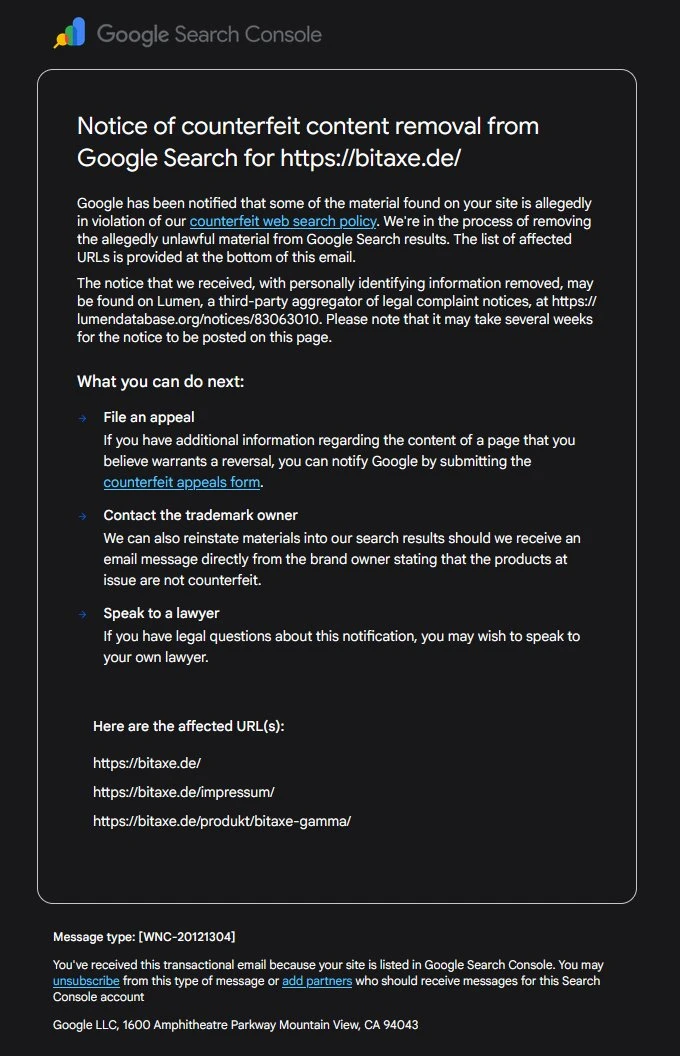
It did not stop at one complaint. The first notice, documented at Lumen under number 83063010, targeted three URLs, among them our home page. The second, Lumen number 84146531, widened the attack to 71 URLs. Sender both times: Bolt Engineering GmbH. Recipient: Google LLC. Type: counterfeit. The complaint text, verbatim:
“The website https://bitaxe.de/[…] is selling products under my registered trademark ‘Bitaxe’ without authorization. The domain name and product listings falsely suggest an official source. The site impersonates my brand, uses my trademark without permission, and misleadingly claims ‘Made in Germany’. Additionally, the legal imprint contains false information and a non-existent address. This constitutes trademark infringement, counterfeit marketing, and consumer deception.”
The wording is the point: my registered trademark, my brand. An open hardware project is presented to Google as the complainant’s own brand, and the sale of genuine open-source devices by another shop as counterfeiting.
Google acted on it and removed all 71 URLs from its index. For a shop whose customers arrive through search, that is not a technicality. It is a collapse in revenue.
We filed a counter-notice and had our lawyers serve Bolt Engineering GmbH with a formal cease-and-desist letter. Google has since restored every single URL, all 71 pages are indexed again today. The damage done during the period of invisibility stands; that part cannot be undone.
The two side allegations are quickly dealt with. The legal notice detail complained of had been corrected long before the complaint was filed, and we reviewed our manufacturing claims and tightened the wording where it could be misread. None of that touches the core of the complaint, which rests on a trademark over a name its owner did not create.
What the other side’s lawyers wrote
We sent a cease-and-desist letter. Their lawyers replied. This is the passage we published in May 2026, translated from the German original:
“Our client had the Bitaxe trademarks you refer to in your letter registered in coordination with the holder of the title rights to the open-source project “Bitaxe”. The enforcement of the trademark rights likewise took place with the knowledge of the holder of the title rights and of the so-called “OSMU” (Open Source Miners United), in which our client is heavily involved and which it has been actively shaping and advancing for years.
Furthermore, our client has in the past granted trademark licences to two substantially larger competitors than your client.”
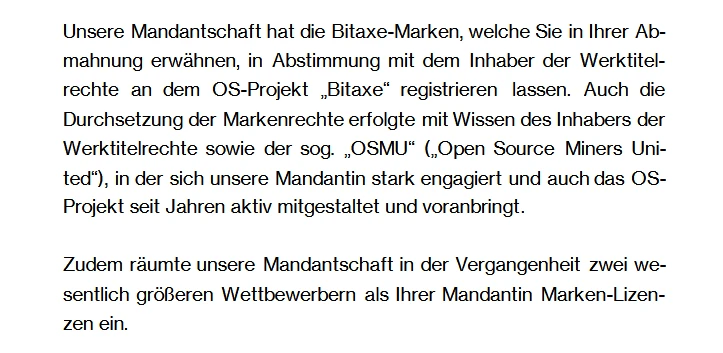
That paragraph makes three claims, all of them by the other side, all of them binding on them:
- The registration happened in coordination with the holder of the title rights, that is, with the author of the Bitaxe project, Skot.
- The enforcement happened with his knowledge and with the knowledge of OSMU. They are therefore conceding that the mark was used against a competitor, and that OSMU knew.
- Trademark licences have already been granted to two larger competitors. A licensing programme exists over the name of an open-source project.
The third point is the most remarkable. Whoever grants licences decides who may use the name and who may not. That kind of control over a project’s name is precisely what open hardware is supposed to rule out.
What the same people said in public
In May 2026 the matter was discussed openly in the Bitaxe project’s repository, in the list of trusted vendors, the legitlist. On 14 May someone requested a review of the solomining.de listing, citing the Lumen record. Four days later the case was closed. Two statements from that thread cannot be reconciled with the lawyers’ letter.
The developer WantClue (@wantclue) wrote on 18 May 2026 at 14:15:
“There is no evidence of any manufacturer in Europe need to ask for permission to sell Bitaxe. Even tho solomining.de owns the trademark it seems this company has never used it for any purpose of restricting competitors. […] the legal problem between solomining and another company exceeds the purpose of this repository.”
Fifty-five minutes later Skot (@skot9000), the founder of the Bitaxe project, closed the case with “I agree, this can be closed as resolved”, and stated in the same comment:
“For the record bitaxeorg owns the Bitaxe trademark and does not recognize or endorse local jurisdictional trademark registrations by others.”
Neither statement fits the lawyers’ letter. The declaration that the project expressly does not recognise such registrations stands against the claim that the registration was made in coordination with the holder of the title rights. And the assertion that the mark had “never” been used to restrict competitors was made 23 days after a complaint aimed at removing 71 URLs of a competitor, and four days before the other side stated that it had licensed two competitors.
We are not saying anyone knowingly said something untrue. We are saying the accounts contradict each other and cannot both be correct.
One observation we will not soften. Skot and WantClue are not bystanders here. They run the project’s trust list, they ended the review, and they placed themselves in front of the vendor instead of condemning the appropriation of the project’s names with so much as a single sentence. From the two voices that carry the most weight in this project there has, to this day, been not one word of criticism of nine trademarks over four project names, but there has been a motion to delist us. That is not neutrality. It is a choice, and it deserves to be called one.
How the contradiction was built up becomes clear when you look at the earliest event in the whole story.
“Our project, our copyright”: how it began in early 2024
The earliest event in this story is also the most revealing, and it begins even before the first complaint. On 18 February 2024 WantClue posted this to the entire membership in the announcements channel of the OSMU Discord (we hold the screenshot):
“@everyone don’t be fooled! Don’t trust verify. Bitaxe.de looks fishy and smells like scam”
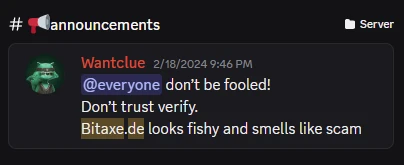
No evidence, no question to us, no way to respond, a warning to the whole community, issued by one of its administrators. A month later, on 18 March 2024 at 16:33, came the formal stage: a complaint filed with Cloudflare, our infrastructure provider. Report type: copyright and DMCA violations. Domain: bitaxe.de. Submitted via info@wantclue.de. From the reasoning:
“I am writing to report a serious violation of both copyright law and the GNU General Public License (GPL) by the website Bitaxe.de […] Our project, Bitaxe (the original project), is an open-source software distributed under the GPL license. […] The website Bitaxe.de hosts a project which is a direct copycat of our Bitaxe project. The operators of Bitaxe.de have not only infringed on our copyright by copying our code without permission but also violated the GPL license […] By not complying with the GPL and falsely presenting a derivative work as their own, Bitaxe.de is misleading users and potentially harming the reputation and integrity of our project, Bitaxe.”
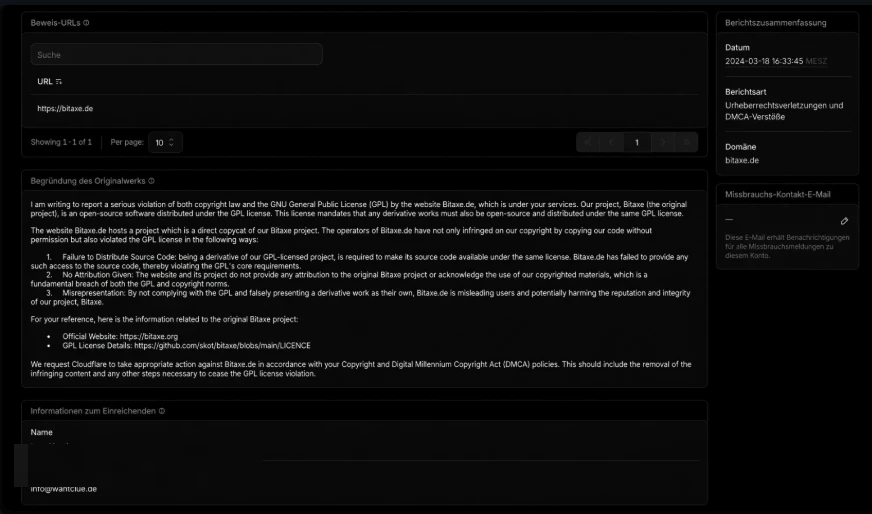
Read the possessives. “Our project”, “our copyright”, “our copyrighted materials”, a community project whose copyright belongs to its authors, first among them Skot, is claimed here in the first person by a single developer, in order to get a competitor’s shop taken down. No Bitaxe trademark existed at the time, incidentally; the first filing came half a year later. Which gives the escalating claims of ownership a clear through-line: in March 2024 it is “our copyright”, by April 2026 it is “my registered trademark”. The project that belonged to everyone became “ours” first, then “mine”.
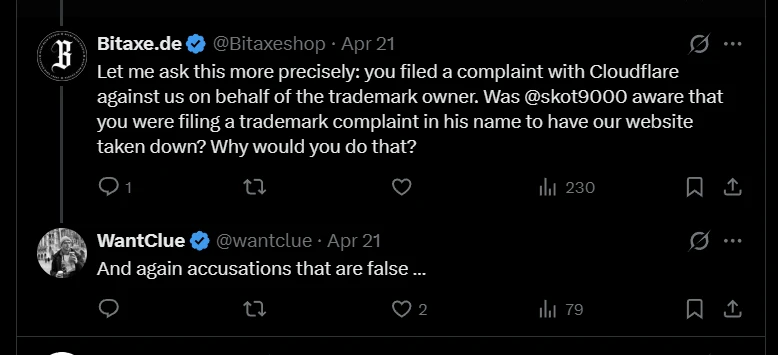
In April 2026 we asked WantClue publicly on whose behalf that complaint had actually been filed: “You filed a complaint with Cloudflare against us on behalf of the trademark owner. Was @skot9000 aware that you were filing a trademark complaint in his name to have our website taken down? Why would you do that?” His complete answer: “And again accusations that are false …”, which question that was meant to answer, he did not say. Either the complaint is wrongly attributed to him, or Skot did not know. Both could be cleared up in one sentence. The sentence never came.
Who gave permission?
The other side’s lawyers gave a clear answer: registration and enforcement took place “in coordination with the holder of the title rights” and “with the knowledge” of OSMU. There is no room to leave open who that means. Title rights in a work belong to whoever created it. The Bitaxe project was created by Skot, who released it under an open licence and who states himself that bitaxeorg holds the Bitaxe trademark. The lawyers cannot mean anyone else.
So the other side’s statement stands against that same man’s own words. On 18 May 2026 Skot wrote publicly that the project does not recognise third-party national registrations. Four days later the trademark owner’s lawyers wrote that this very registration had been made in coordination with him, and enforced with his knowledge. Both cannot be true: either the registration was Bolt Engineering’s own initiative, or it was agreed with the project’s author.
Coordination was denied from another direction too. The same developer who had filed the March 2024 complaint wrote in May 2026:
“There is nothing we can do as this company did file the trademark on their own. Even if we would like to revoke that trademark there is 0 possibility as they did everything according to their jurisdiction. OSMU is not an Organization nor a company.”
A solo effort nobody can do anything about, that is one account. A registration coordinated with the author and enforced with his knowledge, that is the other, from the trademark owner through her lawyers. One of the two is not true. We cannot say which. We can say the question has been open ever since, that a single sentence would settle it, and that the place where it could be asked in public has since been closed and locked.
What happened in May 2026
How the review of all this ended can be read off the timestamps in the project’s public repository, to the minute:
- 14 May 2026: a review of the solomining.de listing is requested, citing the Lumen record. The project founder replies within 23 minutes that this is a matter of German law and outside the repository’s scope.
- 18 May, 14:15: WantClue states that the company has “never used it for any purpose of restricting competitors”, 23 days after a complaint aimed at deleting 71 URLs of a competitor.
- 18 May, 15:10: fifty-five minutes later the case is closed. “I agree, this can be closed as resolved.”
- 18 May, 16:51: in the same thread, aimed at us: “Nothing about Bitaxe.de is looking legit.”
- 22 May 2026: four days after the closure, the trademark owner’s lawyers state that licences were granted to two larger competitors, precisely the opposite of what the exoneration had asserted.
- 18/19 August 2026: the same developer moves to have bitaxe.de removed from the list. Two other participants agree.
You do not have to impute a motive to anyone to see that two different standards were applied. The review of the trademark holder ended after four days on the strength of an assertion with no evidence at all. The review of us has been running since May, demanding documents, screenshots and deadlines, and ended in a motion to delist us.
What word to use for this conduct we leave to the reader. What is documented is the sequence: the appropriation of the project’s names was not condemned, it was shielded, first with an exoneration that has since proven untrue, then with a confirmation offered without evidence, finally with a lock on the discussion. Each of those three steps carries a timestamp and a name.
What the continued listing means
It is worth being clear about what was actually being decided there. The legitlist is not a trade directory anyone can add themselves to. It is the list with which the Bitaxe project itself vouches for vendors, it exists so that buyers can tell genuine sellers from clones and scammers. Being on it means carrying the project’s seal of trust.
The report of 14 May asked exactly one question: can a vendor stay on that list while holding trademarks over the project’s name and using them against another seller? The answer came in the form of the case being closed, and the answer was yes. The listing stands to this day.
A good deal has come to light since, none of which was known at the time: the lawyers’ letter with its licences to two larger competitors, the founder’s confirmation of the payments, the locking of the thread. The listing has not been reviewed again. Nor could a review now be requested in that thread.
So the Bitaxe project continues to recommend a vendor that has registered the project’s own names as trademarks and used them against a competitor. Whether you call that consent or toleration is a matter of wording, either way the seal stays on. And it sits poorly with the public statement that the project does not recognise such registrations: people who consider a registration illegitimate do not usually keep vouching for the party that made it.
The donations: confirmed, not documented
On its “About us” page, solomining.de advertises ongoing support for the developers:
“We support the efforts of the open-source developers by giving a small contribution to the open-source developers for every miner we sell.” (translated from the German original)
Who receives those payments, how much they amount to and on what basis is not stated. That same evidence had previously been demanded of us, and WantClue himself had set the standard: any vendor publicly claiming to support OSMU financially should be able to substantiate it.
On 24 August 2026 that question was put in the Bitaxe project’s repository, in exactly three parts: who received the money, how much was it, what verifiable evidence exists? At 13:05:58 UTC the project founder answered:
“I can also confirm donations from solomining.”
After that, things moved quickly:
| Time (UTC) | Event | Interval |
|---|---|---|
| 13:05:58 | Comment: “I can also confirm donations from solomining.” | — |
| 13:06:16 | The issue is closed. | 18 seconds |
| 13:06:39 | The conversation is locked, only project collaborators may post. | 23 seconds |
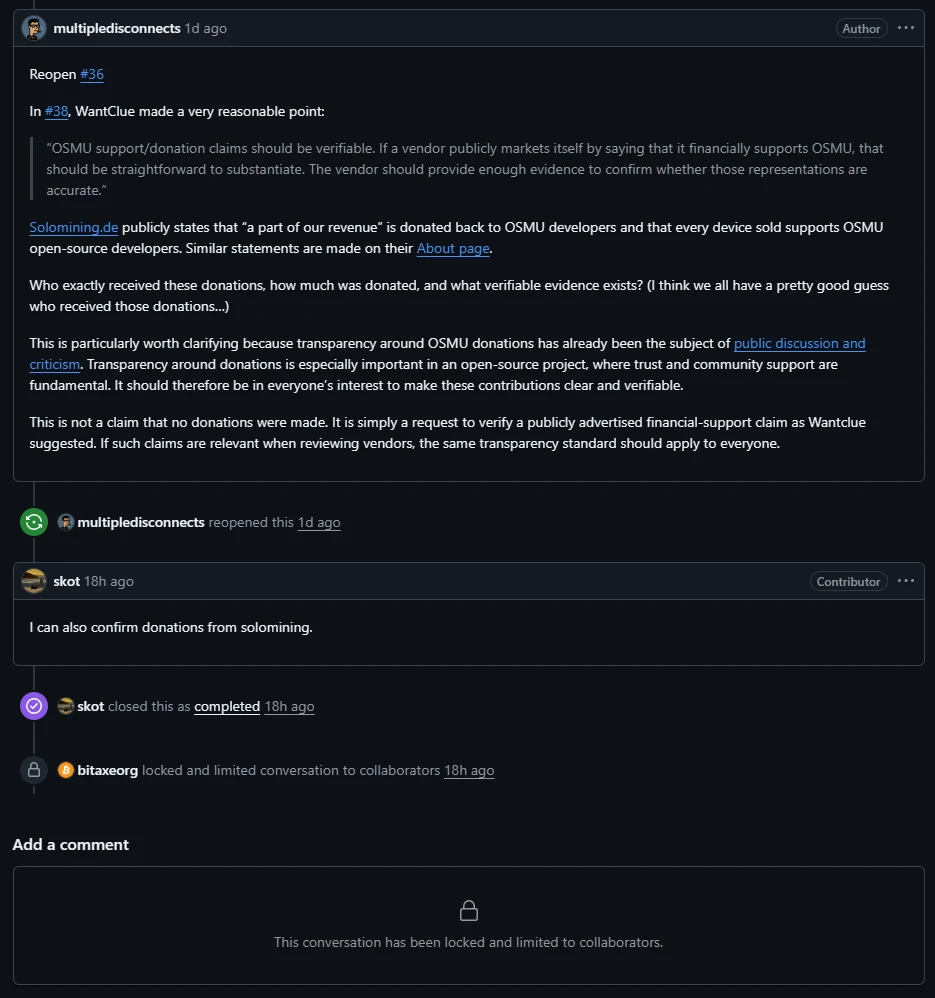
Forty-one seconds from the answer to a closed door. Let us be precise about what that sentence does and does not do. It confirms, for the first time from the project side, that payments were made, until then that was only the vendor’s own marketing. It answers none of the three questions asked: not who received the money, not how much, not what evidence exists. And with the lock in place, the question can no longer be asked there.
The comparison of standards belongs here. When our own wording about donations was at issue, solid evidence was demanded, and we corrected the wording accordingly. When the same question was put to the vendor holding the trademarks, one sentence without evidence sufficed and the discussion was ended. Same process, same list, same people, different standard.
And it fits a pattern that runs through this entire story: not refuting, but locking away. The report citing the Lumen record was met not with clarification but with closure. The question about the donations was met not with evidence but with a lock on the discussion. Our questions on X were met not with an answer but with the blanket charge that they were false. Everything that could bring this matter into the open gets closed, locked or ignored. People who had evidence would show it.
This criticism is not new
The question of OSMU donations was not invented by this dispute. It has been asked in public since late 2024. On 17 December 2024 a user posting as GizmoMiner published a long piece on the bitcointalk.org forum titled “The Truth About OSMU: A Warning to the Bitcoin Community”. He describes himself there as a co-founder of the Discord server that OSMU grew out of, and later as an administrator with access to the internal channels.
We report what it says, and nothing more: it is one person’s account, it is not substantiated, and those named have never replied in that thread. But it is public, it is more than a year and a half old, and it describes the very pattern at issue here. Two passages:
“For years, members have demanded transparency regarding OSMU donations. The reality is, they take in far more money than they disclose and continue to grow their influence under false pretenses. Many members of the OSMU have raised the alarm for transparency, only to be ostracized or ignored.”
“Employed strong-arm tactics, implying that if you don’t pay them from your Bitaxe sales, you’ll be seen as illegitimate.”
The second one is the remarkable sentence. Written in December 2024, it asserts a link between payments out of Bitaxe sales and the question of who counts as a legitimate seller. A year and a half later, a vendor whose payments the project founder has confirmed remains on the recommended list, while the removal of our own entry is under discussion. We are not claiming that one explains the other. We are noting that the description from back then and the events of today resemble each other rather closely.
Two other users added their own experiences to that thread, in June 2025 and in August 2025. The post was not brought up by us, incidentally, but inside the legitlist discussion itself, as evidence that transparency around OSMU donations has been an issue for some time. It went as unanswered there as the question of 24 August 2026.
Can you trademark an open-source project at all?
Legally the answer is that the offices do not check who invented a name. Whoever files first and pays the fee gets the registration. Which makes the more interesting question not whether you may, but what you do with it.
Open hardware runs on a simple trade. The developer gives everything away, schematics, board layout, firmware, bill of materials. Anyone may build it, change it, sell it, commercially, better than he does. What he keeps is one single thing: that the object is named after his project. The name is the last remaining link between the work and the person who gave it away. Registering that name puts into private hands the one thing the developer never handed over.
Then there is the purpose of trademark law itself. A mark is meant to indicate origin: it tells a buyer which house a product comes from. A mark over a community name does not do that, it asserts an origin that does not exist. A Bitaxe does not come from Fellbach. It comes from an open project many people worked on, and it is built by dozens of workshops worldwide. The Google complaint states that false origin quite openly: my registered trademark, my brand.
There is an honest way, and it looks different
You could object that somebody has to file the name, or a third party will. That is true, the table above shows exactly that happening. But the objection comes with a condition, and everything turns on it: who holds the mark, and what happens next?
The template has existed for decades. The Linux Foundation holds the “Linux” trademark and licenses it free of charge to anyone distributing Linux, for the sole purpose of stopping anyone else from locking it up. There are even dedicated legal instruments for this: the collective mark, held by an association, and the certification mark, open to anyone meeting published criteria. A defensive filing in the project’s name, administered for everybody, would be entirely welcome. We would support it and abide by it.
The difference between defence and appropriation comes down to three questions:
- Who is on the register? The project or a trustee, or a single vendor competing in the same market?
- What happens to the rights? Are they kept open to everyone, or granted to some and withheld from others?
- Who is pursued? Free riders abusing the name, or the next-largest competitor, while the free riders are left alone?
By that measure the case answers itself. The registrant is a vendor, not a project. Licences were granted, by their own account, to two larger competitors, and not to us. And exactly one market participant was pursued, while in the same period Chinese applicants registered the same names unopposed.
There is one more test, the simplest of all: would the developers have agreed, if anyone had asked them? The author of the Bitaxe project answered that in public, bitaxeorg does not recognise third-party national registrations. It is hard to be much clearer than that.
Why this goes beyond us
You could file all this under “two shops fighting”. We think it is more than that, for one reason: the names are not a single vendor’s to dispose of.
The Bitaxe became what it is because anyone may download the files, build the device, improve it and sell it. That freedom turned a hobby board into a family of machines built all over the world, from the Gamma to the NerdOctaxe. If the name of that family belongs to one seller, the freedom applies only to the engineering, not to the word the engineering happens under. And without the word, nobody finds it.
Open source is not a business model. It is a promise: what was given away stays given away. Whoever turns the gifted name into a registered monopoly and points it at their own community breaks that promise. And whoever, as project leadership, watches it happen, excuses it, and punishes the one party that never claimed the names for itself breaks it a second time, because the buyers’ trust in the legitlist is as much a common good as the source code is.
In practice, a trademark monopoly over a project name means:
- Whoever builds the device may no longer be allowed to call it that, or needs a licence.
- Whoever sells it can be removed from search engines and platforms by complaint, without a court ever seeing the matter.
- Whoever contributes as a developer finds their project’s name registered to a third party.
- And the buyer ends up finding only the vendors permitted to use the name.
That is what happened to us in April 2026. Not as a threat, but as an accomplished fact: 71 URLs, removed from the index.
What we are asking for
- Clarity about who agreed. The other side, through its lawyers, relies on the consent of the holder of the title rights, Skot, and on the knowledge of OSMU. In public, the opposite has been stated. That question needs answering, by the people named, not by us.
- Disclosure of the licensing programme. If two larger competitors were granted licences: which ones, on what basis, on what terms?
- Verifiability of the confirmed payments, recipient, amount, evidence. That they exist is now confirmed; everything else is open. It is the same standard that was applied to us, and that we accepted.
- An open discussion. Asking for evidence is not an attack. An issue closed and locked 41 seconds after the answer does not remove the doubt, only the ability to voice it.
- And the heart of it: that the names of open projects belong to nobody in particular. We are pursuing cancellation of the marks in so far as they cover project names their owner did not create.
In closing
We would gladly have done without this article. A shop that sells miners ought to be writing about hashrate and heatsinks, not file numbers. But silence stops being an option when 71 pages vanish from search, when the answer to a request for evidence is a locked door, and when the register lists the names of four projects that other people designed in their spare time and gave away.
Seen plainly, this is not a disagreement between shops. A vendor registered the names of four community projects as trademarks and pointed them at its largest competitor, built up over two years, quietly, without a word to the developers whose work gave the names their value in the first place. Two complaints against us; not one against the sellers the protection was supposedly needed for. Anyone who wants to call that brand stewardship has to explain why it only ever works in one direction.
And the people whose job it would have been to call this out did not call it out. They exonerated, closed, locked, and left the recommendation standing. Every one of those steps is on the record, with a date and a time. Taken together they form the picture of a project whose leadership protects a paying vendor and punishes an inconvenient one. We take no pleasure in writing that about a project whose hardware we sell and admire. But that is what the record shows, and nobody has refuted it yet, although a single sentence with evidence attached would do.
We have decided not to let it rest. The takedown has been reversed, the pages are back in the index, the cease-and-desist letter has gone out, the lawsuit is ready. And this article stays online, in both languages, for as long as the questions in it go unanswered.
We know how this looks: a competitor writing about a competitor. So there is nothing in this article you have to take on trust. The trademark data are in the DPMA and EUIPO registers, most easily searched together through TMview. The complaints are in the Lumen database under numbers 83063010 and 84146531. The quotations are in the Bitaxe project’s public repository, the earlier criticism of OSMU donations in thread 5523134 on bitcointalk.org, the catalogue figures in the solomining.de shop, the company details in their legal notice. The extract from the lawyers’ letter comes from our own proceedings; we published it in May 2026. The opposition to “Nerdminer” is shown in the EUIPO register under application 019333841, the operator of bitronics.store in its privacy policy. All retrieved on 24 August 2026, the register data last on 30 September 2026. Go and check, that is the point of listing them.
If anything here is wrong, we will correct it, promptly and in this place. Bolt Engineering GmbH and everyone named may demand a right of reply; we will publish it in full inside this article, with no commentary before or after. The address is in our legal notice. That undertaking has no expiry date.
Beyond that, what held from the beginning still holds: the Bitaxe belongs to nobody. That was rather the point, and that is where it stays.
Is anyone allowed to use the name “Bitaxe”?
What is a bad-faith trademark filing?
Was this not about protecting the name from Chinese copies?
Would a trademark filing by the project itself be acceptable?
One point is worth noting here. It is said that the project holds a worldwide Bitaxe trademark, “bitaxeorg owns the Bitaxe trademark”, as it was put in the repository. In the registers accessible through TMview, which include the EUIPO, the German DPMA and the United States Patent and Trademark Office, no such registration can be found, neither to bitaxeorg nor to Skot nor to OSMU. And in law there is no such thing as a worldwide trademark: protection always arises for a country or an economic area, either by registration or by demonstrable market recognition. That gap is precisely what others moved into.
Are the donations to OSMU developers now documented?
Are the 71 URLs back online?
Who filed the opposition against the Nerdminer trademark?
Which trademarks does Bolt Engineering GmbH hold in total?
Do you buy from solomining.de or resell their products?
How can I verify all this myself?
Matching products


Read more
Bitaxe affiliate program: 5 % commission on every referral, no network in between
Anyone who explains solo mining ends up recommending a miner. With the Bitaxe.de affiliate program you earn on it: 5 % of the net order value of every order via your link or your discount code, 30-day attribution, payout from €50 by SEPA or in Bitcoin. Built in-house, with no affiliate network and no tracking without consent. How the commission works and how to apply.
Guides & knowledgeNerdaxe Gaia: what the BM1373 miner can do, which firmware to run and who it is for
A single BM1373 in the familiar Nerdaxe format: factory settings from the source code, hashrate and power draw with every documented figure, the 12-volt power supply, OSM-OS from the flasher, setup, overclocking up to the current limit, block odds and electricity cost, plus a comparison with the Nerdaxe Gamma, Bitaxe GT and NerdQaxe++.
Guides & knowledgeSetting up Stratum V2 on a Bitaxe: encrypted solo mining in five fields
Since AxeOS 2.14 every Bitaxe speaks Stratum V2, and since September 2026 so does the Bitaxe Pool. This guide walks through the AxeOS fields one by one, shows how to set up the fallback and verify the connection, and lists what goes wrong when no shares arrive. For Bitaxe, NerdQaxe and large ASICs.