

Bitaxe Naja Duo | 8.8 TH/s
Two new BM1373 chips with AxeOS: 4.4 TH/s at about 42 W out of the box, up to 8.8 TH/s overclocked, power supply included
Item no.: 21373 · Manufacturer: Bitaxe.de · Series: Bitaxe
- Two new Bitmain BM1373, 4.4 TH/s at about 42 W out of the box
- Up to 8.8 TH/s at about 103 W overclocked
- AxeOS, 1.9 inch colour display, 120 W power supply included
- Pre-order: expected to ship in late December 2026
- Hashrate
- ~8.8 TH/s (overclocked)
- Efficiency
- ~11.7 J/TH
- Power draw
- ~103 W
plus shipping · −5% with Bitcoin: €474.05
Pre-order · ships from late December 2026
Rather not pre-order? We will ping you
One email as soon as shipping starts (from late December 2026). Nothing else.
Product information
Bitaxe Naja Duo: two BM1373 chips with AxeOS
The Bitaxe Naja Duo is a Bitaxe with two BM1373 chips, the newest Bitmain chip in home miners. Out of the box it delivers 4.4 TH/s at about 42 W, about 9.5 J/TH. Overclocked, it reaches up to 8.8 TH/s at about 103 W. It runs AxeOS, the open-source firmware of the Bitaxe project.
Both chips are new, not used or refurbished. Cooler, fans and colour display are fitted, and a power supply with 12 V and 120 W is included. The Naja Duo is available to pre-order and is expected to ship in late December 2026.
Two operating modes: frugal or fast
The Naja Duo has two operating points: out of the box and overclocked. Actual values depend on the individual unit, the room temperature and the settings.
- Out of the box: 4.4 TH/s at about 42 W, about 9.5 J/TH. Clock 327 MHz, core voltage 1,000 mV.
- Overclocked: up to 8.8 TH/s at about 103 W, about 11.7 J/TH. Clock 650 MHz, core voltage 1,100 to 1,150 mV.
The factory setting also adds up: at 327 MHz with two BM1373, AxeOS expects about 4.4 TH/s. Where the formula comes from and why the firmwares count the BM1373 differently is explained in the BM1370 vs BM1373 chip comparison.
Overclocking to up to 8.8 TH/s
For the fast operating point you set 650 MHz at 1,100 to 1,150 mV. The AxeOS drop-down for the Naja Duo goes up to 410 MHz and 1,250 mV; higher clock values are entered by hand in the AxeOS overclock mode. How that works and what to watch out for is shown in the overclocking guide.
A higher clock brings more hash rate but costs disproportionately more power: for twice the hash rate the Naja Duo needs about two and a half times the power. Go in small steps and keep an eye on temperature and error rate.
Two chips in series
The two BM1373 sit in series on the board, each in its own voltage domain. The voltage regulator therefore supplies twice the core voltage, 2 V instead of 1 V out of the box. At twice the voltage the same power needs only half the current, which takes load off the regulator and the traces. How this works in detail is explained in the voltage domains section of the chip comparison.
The board is made with 2 oz copper, about 70 µm instead of the usual 35 µm. More copper carries current and heat better, which mainly benefits the power delivery.
Cooler with heat pipes and a second fan
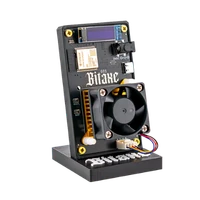
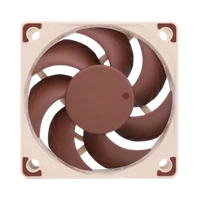
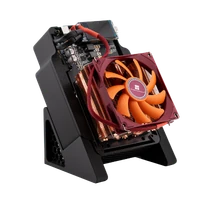
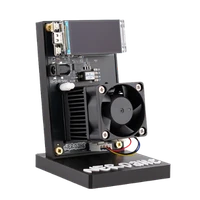
A purpose-built cooler with heat pipes and a dense fin stack sits on the chips, and a fan on top pushes air through it. On the back of the board a second fan with 80 × 80 × 10 mm and 3,000 rpm cools the board and the power delivery, which helps above all when overclocked.
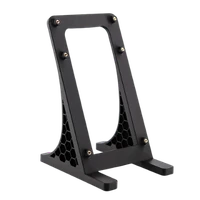
Board and cooler sit at an angle in a black stand with a honeycomb structure. That keeps the display easy to read and lets air flow freely through cooler and fans.
AxeOS and colour display
The Naja Duo runs AxeOS, the open-source firmware of the Bitaxe project. The board carries the number 1201, and AxeOS has supported it since version 2.15.2 from September 2026. In the web interface in your browser you see hash rate, temperature and power, set clock and core voltage and install updates. You set pool, worker and Bitcoin address yourself; you need no account and no cloud.
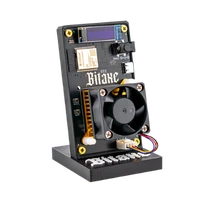
The 1.9 inch colour display with 170 × 320 pixels shows the key values right on the device. The Naja Duo joins your home network over 2.4 GHz Wi-Fi.
Power and power supply
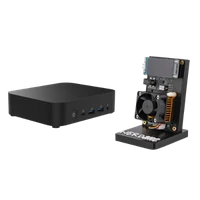
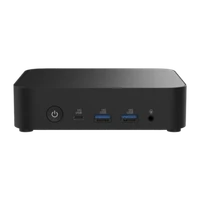
The Naja Duo runs on 12 V. The box contains a 120 W power supply that covers both operating modes: out of the box the miner needs about 42 W, overclocked about 103 W. So all you need is a socket.
Running around the clock, the Naja Duo uses about 30 kWh a month out of the box and about 75 kWh overclocked. What that costs at your tariff is worked out by the mining calculator with your own figures. All of the power ends up as heat in the room. Stand it in the open and not in a closed cabinet.
The Naja Duo compared
- Nexus S1-01: also two BM1373, around 5 TH/s at roughly 80 W with the NMAxe firmware and an Ethernet port. Out of the box the Naja Duo reaches a similar hash rate at about half the power and runs AxeOS.
- NerdQaxe++: four BM1370, around 4.8 TH/s at roughly 80 W. Out of the box the Naja Duo delivers almost the same hash rate at about half the power.
- Bitaxe GT: two BM1370, 2.15 TH/s at 43 W. At similar power the Naja Duo brings about twice the hash rate out of the box.
- Nerdaxe Gaia: one BM1373 with NerdOS. The Naja Duo carries two of these chips and runs AxeOS.
The figures of the other models are on their product pages, together with where they come from.
Solo mining with the Naja Duo
Every hash is a ticket in the same draw the large farms take part in. If your Naja Duo finds the matching block, the full reward of currently 3.125 BTC plus transaction fees goes to your own address, undivided and with no provider in between. Out of the box you hold more than three times as many tickets as with a Bitaxe Gamma, overclocked almost seven times as many. That does not change the order of magnitude of the chance; solo mining stays a matter of luck. How small it is, is shown in the article on the odds of finding a block.
Our solo pool pool.bitaxe.de runs in Frankfurt and charges a 0 % fee. The principle is explained in Bitcoin solo mining.
Pre-order: expected to ship in late December 2026
The Naja Duo is sold as a pre-order. Shipping is expected to start in late December 2026, and orders go out in the order they were placed. You secure a unit from the first delivery, but you will have to wait until late December for it.
Up and running in minutes
Power, your Wi-Fi and a browser are all you need for setup. The power supply is in the box.
- 1
Connect it
Plug the included 12 V power supply into the miner and into the socket. The miner starts.
- 2
Join your Wi-Fi
On first boot the miner opens its own Wi-Fi network. Switch to that network, pick your 2.4 GHz home network and enter the password. The miner is then reachable through your router, and its IP address appears on the display.
- 3
Enter pool and address
Open AxeOS in your browser, enter the pool and your Bitcoin address, save and restart. For our solo pool that means host
stratum.bitaxe.de, port3333.
Who the Naja Duo is for
For everyone who wants a lot of hash rate on little power and wants to stay with AxeOS. Out of the box it is frugal; if you want more, overclock it to up to 8.8 TH/s.
It is less of a fit if you want to connect the miner with an Ethernet cable: the Naja Duo only uses 2.4 GHz Wi-Fi, while the Nexus S1-01 has an Ethernet port. And if you are looking for a small, quiet Bitaxe to start with, the Bitaxe Gamma serves you well.
Ready for the Naja Duo?
Two new BM1373 chips, 4.4 TH/s at about 42 W out of the box and up to 8.8 TH/s overclocked, AxeOS, a colour display and a power supply in the box: the Naja Duo gets a lot of hash rate out of two chips on little power.
Bitaxe Naja Duo compared to similar miners
| Model | Hashrate | Power | Efficiency | Price |
|---|---|---|---|---|
| NerdQX | ~8 TH/s | ~140 W | ~17 J/TH | €469.00 |
| Bitaxe Naja Duo (this page) | ~8.8 TH/s (overclocked) | ~103 W | ~11.7 J/TH | €499.00 |
| Nexus S1-02 | ~10 TH/s | ~150 W | ~15 J/TH | €699.00 |
All values are guide figures. Compare all miners, calculate power cost.
Frequently asked questions about the Bitaxe Naja Duo
When does the Bitaxe Naja Duo ship?
How much hash rate does the Naja Duo have?
How much electricity does the Naja Duo use?
Which chips are inside the Naja Duo?
How do I overclock the Naja Duo?
Which firmware does the Naja Duo run?
How is the Naja Duo cooled?
How loud is the Naja Duo?
Is a power supply included?
Does the Naja Duo work on 5 GHz Wi-Fi?
Can I solo mine with the Naja Duo?
Naja Duo or Nexus S1-01?
Naja Duo or NerdQaxe++?
Why buy from Bitaxe.de?
Free shipping from 200 €
Free shipping to almost every EU country from 200 €, shipping to the EU and Switzerland with UPS and a tracking link. Items in stock leave within 24 hours, with no customs surprises inside the EU.
Truly open source
Bitaxe, Nerdaxe, NerdQaxe & co. are open hardware running open firmware (AxeOS or NerdOS): you set pool, clock and voltage yourself. No cloud account, no vendor lock-in, no black box.
CE, warranty & returns
Every product carries the CE marking. Plus statutory warranty and a 14-day right of withdrawal for a safe order. If something is not right, we find a solution with you, person to person.
Direct support
Questions about setup, pool, firmware or your order? By email or Telegram you get help from someone who runs these devices themselves, in English or German, beginners welcome.
Related guides
Setup, pool, cooling, power supply and sensible upgrades for your setup.
You might also like
 Vorbestellung
Nexus S1-01 | 5 TH/s

NerdQaxe++ Rev7 | 4.8 TH/s

Bitaxe GT | 2.15 TH/s
